10-06-2026
KOL Management for Mid-Sized Biotech Companies
In the life sciences industry, the companies who become successful aren't those with the greatest KOL networks but the ones that get their KOL management strategy right. They win because they built the right relationships, at the right stage, with the right depth of engagement. For mid-sized biopharma companies, this is the growth phase where that distinction matters most, where KOL strategy either becomes a genuine competitive advantage or never fully delivers. This guide breaks down exactly how to get it right and where to begin.
In this Article
- Why the Large Pharma KOL Model Does Not Work for Mid-Sized Biopharma Companies
- How to Build a Scalable KOL Strategy: A Practical Guide
- KOL Management Software for Biopharma: What to Look For and Why It Matters
- Final Thoughts
- FAQs
Why the Large Pharma KOL Model Does Not Work for Mid-Sized Biopharma Companies
Mid-sized biopharma companies are at a pivotal stage. They have a late-stage pipeline, possibly an approved product, and growing commercial ambitions but they do not yet have the infrastructure that large pharma uses to manage KOL relationships at scale.
This is the point where KOL strategy either becomes a real organizational strength or moves with no proper direction.
Large pharma builds KOL programs on top of established infrastructure such as dedicated medical affairs teams, structured engagement frameworks, and systems managing hundreds of relationships across geographies. Their model is built entirely for scale.
Mid-sized companies are still building that foundation. Teams are growing, pipelines are expanding, and KOL engagement is increasing in complexity. But the systems and structure to manage it have not always kept pace. KOL data sits across disconnected tools.
Different teams engage the same experts without visibility into each other's interactions. There is no single, consolidated view of who is being engaged, how often, and to what effect.
The result is a KOL strategy that works in parts but not as a coordinated organizational strategy. At a stage where every expert relationship carries significant weight, that gap is worth closing.
How to Build a Scalable KOL Strategy: A Practical Guide
- Identify the right KOLs: KOL mapping needs to extend beyond familiar names and known contacts. The most relevant experts are not always the most published, they are the ones who shape clinical opinion, lead sessions at major congresses, and whose perspectives carry weight with peers and regulators. Network influence and conference analysis consistently surface high-value names that standard commercial databases tend to miss.
- Keep tiering simple and actionable: As organizations grow, KOL tiering frameworks often become increasingly complex. While detailed models may seem useful, they can make it harder for teams to clearly identify and prioritize the experts who matter most. A more effective approach is to focus on a core group of high-priority KOLs, invest in building and maintaining those relationships over time, and stay connected with the broader clinical community without overcomplicating engagement strategies.
- Structure advisory boards: Advisory boards deliver the greatest value when they are built around genuine scientific dialogue. Keeping them smaller in size, held at regular intervals, and focused on addressing real scientific questions creates an environment for open, high-quality discussions. The most valuable advisory board conversations occur when experts feel they are actively shaping scientific thinking and providing insights, rather than simply receiving information or updates.
- Invest in MSL capability before it feels urgent: Field medical relationships are what determine whether a KOL program scales with quality or simply grows in volume. MSLs who combine scientific credibility with genuine curiosity about clinical practice take time to find and develop. Organizations that treat MSL investment as a strategic priority rather than a reactive hiring decision consistently build stronger and more durable expert networks over time.
Identifying the right KOLs is the foundation. Translating that into a field strategy is the next step. See how konectar supports strategic field planning.
KOL Management Software for Biopharma: What to Look For and Why It Matters
As teams grow, identifying the right KOLs, tracking engagement, and consolidating interactions from multiple systems becomes difficult. Without a structured system, there is no way to maintain visibility across teams, preserve relationship history, or ensure consistent follow-ups.
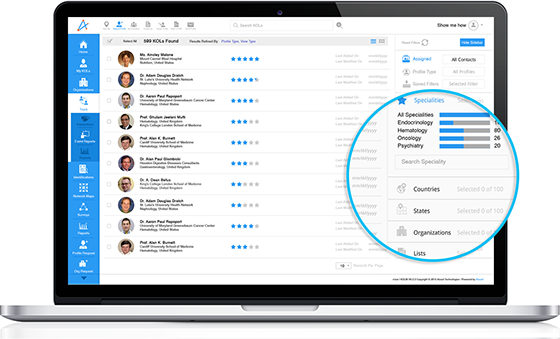
konectar addresses this directly. It crawls millions of data points to identify and analyze the KOLs that matter most to your therapy area, covering clinical trial involvement, congress participation, affiliations, and more. This reduces the manual effort KOL mapping has traditionally required. It surfaces top experts, including rising stars outside your existing network, in a fraction of the time.
On engagement level, konectar CRM enables teams to log every touchpoint, track relationship, and gives leadership full visibility into who is being engaged, by whom, and how frequently across geographies. Duplicate outreach is eliminated and every team works from the same intelligence.
See how konectar helps your team identify the right KOLs and manage every engagement in one place. Request a Demo
Final Thoughts
Effective KOL management is not about engaging more experts. It is about creating a consistent, scalable approach to identifying, prioritizing, and nurturing the relationships that matter most. For mid-sized biopharma companies, this is often the stage where informal processes must evolve into a structured strategy that can support future growth.
Organizations that establish clear KOL engagement practices early make more informed decisions as they advance their clinical and commercial goals.
FAQs
- What is the difference between KOL identification and KOL mapping?
KOL identification is about finding the right experts. KOL mapping is understanding how experts connect to each other, to institutions, and to a therapy area.
- How do mid-sized biotech companies typically manage KOL data?
Most start with spreadsheets or general CRM tools. As teams grow, this creates visibility gaps as different teams may engage the same experts without awareness of each other's activity. There is no centralized view of who is being engaged, and critical relationship history often lives in individual inboxes rather than a shared system.
- How is a KOL different from a thought leader?
A KOL has demonstrated peer influence within a specific clinical or scientific community. A thought leader is a broader term, not every thought leader carries the same clinical credibility or peer trust as a recognized KOL.
- How does konectar CRM support KOL engagement?
konectar CRM allows teams to log every interaction, track engagement quality, and maintain complete relationship history in one centralized place. Leadership and regional teams have full visibility into engagement activity across geographies, eliminating duplicate outreach and ensuring consistent engagement. As the organization grows, every team stays aligned on who is being engaged, how, and by whom.
- How does konectar help with KOL identification?
konectar crawls millions of data points to identify and analyze KOLs relevant to your therapy area. Each profile covers complete professional activities, giving medical affairs, commercial, and strategy teams a clear picture of KOLs influence. This significantly reduces manual research effort and surfaces high-value experts in a fraction of the time.
Read Next
Planning a launch? This one is worth your time. Launch Intelligence: A Pre-Market Imperative for Teams with NDA (New Drug Application) Filed


Recommended