20-07-2026
Agentic AI in Life Sciences: Everything You Need to Know
Agentic AI in life sciences refers to AI systems that can independently plan, reason, retrieve trusted scientific data, and execute multi-step workflows to achieve a defined objective. It enables pharmaceutical, biotech, medtech, and diagnostics teams to automate complex tasks, access actionable insights faster, and make more informed decisions with minimal manual intervention.
In this article:
- How is Agentic AI Different from Generative AI?
- Why is Agentic AI Important for Life Sciences?
- Agentic AI Use Cases in Life Sciences
- Why Does Data Grounding Matter?
- Agentic AI vs. Generative AI: A Side-by-Side Comparison
- How konectar AI (kAI) Brings Agentic Intelligence to Life Sciences
- Frequently Asked Questions (FAQs)
Unlike traditional AI tools that respond to one prompt at a time, agentic AI can determine the next logical step, gather information from multiple sources, evaluate its findings, and deliver a complete outcome. This shift enables teams to spend less time on manual research and more time on strategic decision-making.
How is Agentic AI Different from Generative AI?
Generative AI and agentic AI are often used interchangeably, but they serve different purposes.
Generative AI excels at creating content such as summaries, emails, reports, and answers to questions. However, it typically waits for user instructions at every step.
Agentic AI goes further. It works toward a defined objective by planning a sequence of actions, retrieving relevant information, and completing multi-step tasks with minimal guidance.
For example, if asked to summarize a KOL's publication history, a generative AI tool will generate a summary. An agentic AI system preparing an MSL for a meeting can identify the relevant KOL, analyze recent publications and clinical trial activity, review conference participation, prepare a briefing document, and highlight discussion opportunities—all within a single workflow.
Why is Agentic AI Important for Life Sciences?
Life sciences organizations work with enormous volumes of scientific publications, clinical trial data, conference information, healthcare professional profiles, and organizational relationships. Much of this information is scattered across multiple sources, making manual research time-consuming and difficult to maintain.
Agentic AI addresses this challenge by bringing together relevant information, analyzing it in context, and presenting actionable insights. Instead of helping users complete one task at a time, it helps complete entire workflows, enabling faster and better-informed decisions across the organization.
Agentic AI Use Cases in Life Sciences
KOL Identification and Mapping
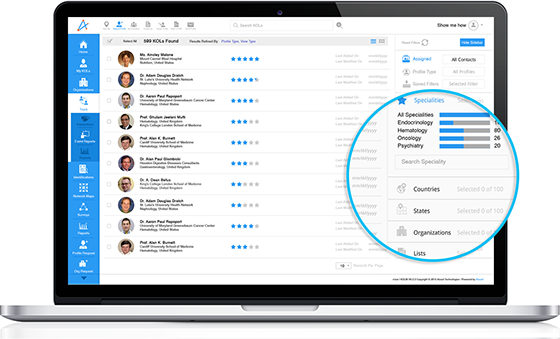
Finding the right Key Opinion Leaders (KOLs) often requires reviewing publications, clinical trials, conference presentations, and institutional affiliations. Agentic AI automates this process by searching across multiple trusted sources, identifying relevant experts, mapping relationships, and highlighting emerging voices in specific therapeutic areas.
Medical Affairs and MSL Support
Medical Affairs teams spend significant time preparing for scientific exchanges. Agentic AI can consolidate an HCP's publications, clinical interests, speaking engagements, collaborations, and recent scientific activity into a single briefing, allowing MSLs to enter conversations better prepared while reducing manual research.
Conference and Congress Planning
Preparing for major congresses traditionally involves weeks of planning. Agentic AI can analyze conference agendas, identify relevant sessions, match them with priority KOLs, recommend meeting opportunities, and generate personalized engagement plans before the event.
Clinical Development
Clinical teams can use agentic AI to identify investigators, monitor ongoing clinical trials, discover emerging researchers, and analyze therapeutic landscapes. This enables faster site selection and supports evidence-based planning throughout the clinical development process.
Commercial Strategy
Commercial teams can leverage agentic AI to identify influential experts, monitor market developments, understand competitive activity, and support launch planning with continuously updated intelligence.
Why Does Data Grounding Matter?
In life sciences, the quality of AI is only as good as the data behind it.
An AI system that generates convincing but inaccurate information can introduce significant business and compliance risks. Whether preparing for an HCP engagement or supporting launch strategy, decisions must be based on trusted, current, and traceable information.
Effective agentic AI should therefore retrieve information from verified and continuously updated scientific sources instead of relying solely on pre-trained knowledge. Data grounding improves transparency, reduces hallucinations, and gives users greater confidence in AI-generated recommendations.
What Are the Benefits of Agentic AI in Life Sciences?
Organizations adopting agentic AI can benefit from:
- Faster KOL identification and expert mapping
- Reduced manual research and administrative work
- Better preparation for HCP engagements
- Continuous monitoring of publications and clinical trials
- Improved conference intelligence, planning and follow-up
- Faster access to scientific insights
- More informed commercial and clinical decision-making
- Greater productivity across Medical Affairs, Commercial, Clinical Development, and Business Development teams
Rather than replacing experts, agentic AI augments their expertise by automating repetitive research while allowing people to focus on strategic and scientific decisions.
How Can Life Sciences Organizations Get Started?
Organizations should begin with focused, high-value workflows where agentic AI can deliver measurable improvements.
Good starting points include KOL identification, publication monitoring, conference planning, and Medical Affairs preparation. As adoption grows, organizations can expand into broader workflows while maintaining human oversight for regulatory, scientific, and external-facing decisions.
When evaluating agentic AI solutions, organizations should consider:
- Whether the system retrieves information from trusted and continuously updated sources.
- How transparent and explainable its outputs are.
- Whether it can complete multi-step workflows rather than simply answering questions.
- How well it integrates with existing life sciences workflows and data.
Agentic AI vs. Generative AI: A Side-by-Side Comparison
Capability | Generative AI | Agentic AI |
|---|---|---|
| Primary purpose | Generates content or answers based on user prompts | Achieves a defined objective by planning and executing multi-step workflows |
| How it works | Responds to one prompt at a time | Plans, reasons, retrieves data, and determines the next best action |
| Workflow execution | Assists with individual tasks | Completes end-to-end workflows with minimal manual intervention |
| Data usage | Primarily relies on prompts and pre-trained knowledge | Retrieves and synthesizes trusted, up-to-date data from multiple sources |
| Decision-making | Requires users to guide each step | Makes decisions within predefined rules and goals |
| Adaptability | Limited to the current interaction | Adjusts its workflow as new information becomes available |
| Example: KOL identification | Summarizes a KOL's publications when asked | Identifies relevant KOLs, analyzes publications, clinical trials, speaking engagements, collaborations, and prepares a complete engagement brief |
| Example: Congress planning | Summarizes conference sessions | Identifies priority sessions, maps relevant KOLs, and generates personalized engagement plans |
| Human involvement | High — users direct every step | Lower manual effort, with humans providing oversight and final decisions |
| Best suited for | Drafting content, summarization, translation, brainstorming, and question answering | Medical Affairs, KOL intelligence, conference planning, publication monitoring, and commercial strategy |
How konectar AI (kAI) Brings Agentic Intelligence to Life Sciences
konectar AI (kAI) is the intelligent AI assistant built into konectar that helps life sciences teams discover insights, analyze HCP data, and complete research-intensive tasks faster.
Powered by advanced AI and konectar's expert-verified life sciences intelligence, kAI enables users to ask natural language questions and receive contextual, data-backed answers within seconds. It helps identify KOLs, analyze publication trends, understand HCP expertise, prepare for stakeholder engagements, and surface emerging scientific developments—all while significantly reducing manual effort.
By combining trusted data with intelligent workflow support, kAI helps Medical Affairs, Commercial, Clinical Development, and Business Development teams make faster, more informed decisions. Experience how kAI transforms life sciences intelligence. Book a personalized demo today.
Frequently Asked Questions
- What is agentic AI in life sciences?
Agentic AI refers to AI systems that independently plan, reason, retrieve trusted scientific data, and execute multi-step workflows to support decision-making across life sciences organizations.
- How is agentic AI different from generative AI?
Generative AI creates content in response to prompts, while agentic AI plans and completes multi-step workflows by combining reasoning with trusted data retrieval.
- Which life sciences teams benefit most from agentic AI?
Medical Affairs, Commercial, Clinical Development, Business Development, Market Access, and Clinical Operations teams can all benefit from agentic AI.
- Can agentic AI replace human expertise?
No. Agentic AI is designed to augment human expertise by automating research and analysis while keeping people responsible for scientific, clinical, and strategic decisions.
- Why is trusted data important for agentic AI?
Trusted, continuously updated, and traceable data improves the accuracy, transparency, and reliability of AI-generated insights, reducing the risk of incorrect recommendations.
Read Next
How AI-Powered Platforms Support More Structured HCP Discovery


Recommended