28-08-2026
From Engagement Planning to Long-Term Partnership: Managing the HCP Lifecycle
The adoption of life sciences-specific CRM built around HCP engagement is growing faster. It is enabling teams to look for more data-driven, structured, and compliant ways to manage relationships. It also equips them with answers to questions like how well interactions were captured, who the real decision-makers and influencers are, how their preferences and history are tracked, and how that information can be turned into the next right action.
In the article:
- Why driving long-term HCP engagement has become difficult
- Planning engagement that actually compounds
- See how konectar CRM can support life sciences teams-HCP engagement
- Conclusion
- FAQs
Why driving long-term HCP engagement has become difficult
HCPs have become more selective than they used to be. A few patterns describe just how constrained physician and surgeon access has become.
A growing number of HCPs now place restrictions on sales rep visits. The physicians who remain most in-demand are already fielding a high volume of rep visits, which means volume of outreach is no longer a differentiator; relevance and timing are what matter now.
Many accessible HCPs are narrowing the number of companies they will engage with at all. A growing share of physicians now require a scheduled appointment to see a rep.
For medical device companies, this is compounded by the fact that HCP relationships are rarely one-to-one. A single procedure decision at a hospital might involve a surgeon, a hospital value analysis committee (VAC), procurement, and nursing leadership, each with different priorities and different windows for discussion.
Value analysis committees alone can have multiple members spanning clinical, financial, and supply chain roles, and increasingly hold the real approval power. Generic CRM, built around a single contact and a typical linear sales funnel will not suit this structure.
Planning engagement that actually compounds
Furthermore, an expert identified at a congress this year might not immediately prescribe or advocate for another few months. Once a relationship is established, every touchpoint, right from initial engagement to sustained scientific exchange, advisory board participation, and account-level trust, has to be recorded, analyzed, and worked on.
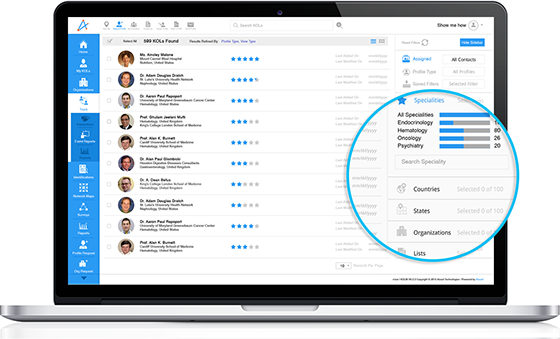
Long-term HCP relationships rest on comprehensive HCP history and a structured way to plan and drive engagement. konectar CRM is built around these, without adding process overhead to already stretched Medical Affairs, MSL, and Commercial teams.
A single, verified record of every HCP. Every interaction across congresses, field visits, scientific exchanges, and digital touchpoints lives against one profile instead of being scattered across spreadsheets, inboxes, and individual reps' memory. When access to HCP is difficult to obtain, no team can afford to ask an HCP the same question twice or lose context to another colleague who has already built it.
A structured plan for what comes next. Every HCP relationship can carry its own objectives and plan of engagement, built on interactions recorded as they happen. Sentiment, belief, and advocacy have to be tracked over time, so a team can see whether a relationship is strengthening or drifting, irrespective of how many touchpoints occurred. Reports built on that history point to the next best action for each HCP, so follow-up is driven by what the relationship actually needs rather than what is easiest to schedule.
This becomes especially true for organizations navigating multi-stakeholder decisions and increasingly selective HCPs. The difference between managing contacts and managing relationships comes down to whether the system was built for this world or adapted from a generic sales model that predates it.
See how konectar CRM can support life sciences teams-HCP engagement
Most CRM built for general sales was never meant to fulfill the realities of scientific engagement. As against this, konectar CRM is built specifically for life sciences.
That means every scientific exchange, congress interaction, and advisory conversation can be planned with intent, whether it is deepening a relationship already in motion or making a first, well-informed approach to a new HCP.
The result for organizations is also a complete picture of every relationship across teams and functions, with the right visibility for each function. Medical Affairs, MSL, and Scientific teams can work from the same underlying history while specific data stays visible only to the teams that should see it, keeping the setup aligned with boundaries.
konectar CRM is also customizable, which means the system can be shaped around a team's specific requirements rather than the other way around. Workflows or fields can be set up to match how a particular Medical Affairs, MSL, or Scientific team actually works, so the CRM adjusts to the team instead of the team adjusting to it.
If you are looking to plan and sustain HCP engagement more effectively, request a walkthrough of konectar CRM to see how it fits into your existing workflow.
Conclusion
Teams that keep treating HCP engagement as a linear, single-contact sales process will keep losing ground to teams that treat it as an HCP engagement lifecycle: a long-term stakeholder relationship that has to be tracked, tiered, and nurtured with intent. A CRM purpose-built for life sciences gives teams the structure to do exactly that, from the first interaction to a partnership that lasts years.
FAQs
- What is HCP lifecycle management?
HCP lifecycle management is the process of tracking, planning, and nurturing an HCP relationship from initial identification and engagement through ongoing scientific exchange and long-term partnership.
- Why is a traditional CRM not enough for HCP engagement?
Traditional CRMs are often built around linear sales processes and individual contacts. HCP engagement can involve multiple stakeholders, longer relationship cycles, and different engagement objectives, requiring a more flexible, relationship-focused approach.
- How does CRM help improve long-term HCP engagement?
A purpose-built CRM brings interaction history, engagement objectives, preferences, and follow-up plans into one place, helping teams make more relevant decisions at every stage of the relationship.
- Can multiple life sciences teams use the same CRM?
Yes. A life sciences CRM can support teams across Medical Affairs, MSL, Scientific, and other functions, helping each team plan, manage, and drive HCP engagement based on its specific objectives and workflows.
- How can konectar CRM support the HCP lifecycle?
konectar CRM helps teams maintain a complete HCP profile, plan and track engagement, capture interactions across channels, and use relationship history to guide future engagement throughout the HCP lifecycle.


Recommended