24-09-2026
Sentiment Shifts in Healthcare: Are Your HCPs Still Champions?
In life sciences, one of the most underestimated risks a Medical Affairs or Commercial team can face is that their strongest HCP advocates quietly stop believing in a brand. The gradual drift from an enthusiastic champion to passive observer to, in some cases, a voice that now amplifies a competitor.
Sentiment shifts in healthcare happen slowly and by the time most teams notice, the impact on relationships, prescribing behavior, and pipeline momentum can be significant. So the real question is: Are your HCPs still champions, and do you have a way to know for certain?
In this article
- Types of HCPs in the Belief Journey
- How konectar CRM Helps Track Changing HCP Sentiment
- How to Rebuild Momentum When HCP Sentiment Changes
- The Bottom Line
- FAQs
Types of HCPs in the Belief Journey
HCP perspectives can vary in their level of support, engagement, and openness toward a therapy. Viewing these perspectives as a spectrum can help teams understand where an HCP currently stands and how their position may evolve as they encounter new evidence, clinical experiences, or scientific discussions.
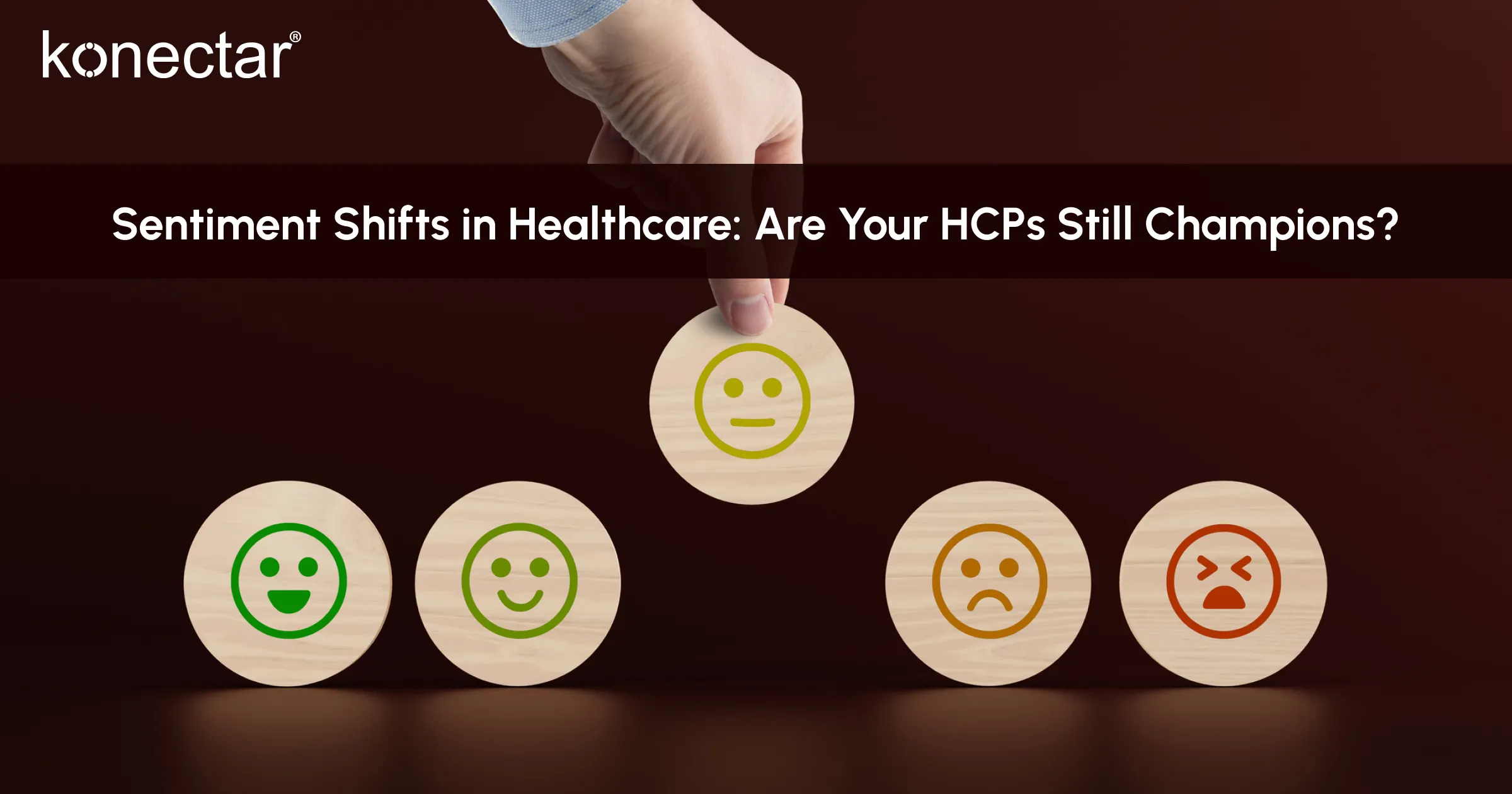
HCPs may be described using different terms based on their level of support, sentiment, and engagement with a therapy. Common descriptions include:
Champion
Strongly supports the therapy and is willing to advocate for it through scientific discussions, peer interactions, or other forms of engagement.
Supporter
Has a positive view of the therapy and engages with relevant scientific content but may not actively advocate for it.
Neutral
Has no strong positive or negative position and remains open to evaluating new evidence, experiences, or treatment options.
Skeptic
Has growing questions or reservations about the therapy and may increasingly seek alternative evidence or perspectives.
Detractor
Holds a clearly negative view of the therapy and may actively express concerns or favor alternative treatment approaches.
HCP perspectives can evolve due to factors such as inconsistent follow-ups, more relevant engagement from competitors, limited recall of scientific information, or gaps in ongoing relationship management.
How konectar CRM Helps You Track Changing HCP Sentiment
Field teams are often the first to notice changes in an HCP’s perspective, but without a structured system, these signals can get lost across email threads, call notes, and siloed CRM entries. Capturing these observations in the form of interactions in a consistent way can help teams build a clearer picture of how HCP sentiment evolves over time.
konectar CRM, a purpose-built platform for life sciences teams, goes beyond standard engagement tracking by bringing relevant HCP information and engagement context together. Through its Advocacy & Belief features, konectar CRM enables teams to track how an HCP’s belief in a therapy or scientific message evolves over time. This helps teams recognize changes in HCP perspectives earlier and adapt their engagement accordingly, rather than responding only after the relationship has been affected.
How to Rebuild Momentum When HCP Sentiment Changes
When an HCP’s perspective changes, understanding what has changed can help teams decide how to approach the next interaction. A useful framework includes:
Explore the Underlying Concerns
Rather than immediately responding with more data, create space for an open scientific exchange. Understand what the HCP is seeing in practice, what questions they have, and what evidence may address those questions.
Bring Fresh Evidence
Relevant and recent evidence can help address evolving scientific questions, whether from new analyses, real-world evidence, or emerging clinical research.
Create Scientific Dialogue
Meaningful scientific exchange can involve HCPs in appropriate activities such as advisory discussions, research collaborations, or scientific programs.
Reassess Your Engagement Frequency
Review how often and why you engage with the HCP. Interactions should be guided by their scientific needs and provide meaningful value.
Enable Peer-to-Peer Influence
Where appropriate, peer-to-peer scientific exchange can provide another avenue for discussion, collaboration, and knowledge sharing.
The Bottom Line
HCP sentiment isn't static. Treating it as something that can evolve over time, rather than assuming it remains unchanged, can help teams maintain a clearer understanding of HCP perspectives.
By consistently capturing relevant interactions and observations, teams can better recognize changes in sentiment and adapt their engagement accordingly.
FAQs
- How is konectar CRM different from a standard CRM for this use case?
konectar CRM is purpose-built for life sciences and brings scientific, and provide life sciences teams with broader context around HCP relationships and changing perspectives than a CRM focused primarily on activity tracking.
- How often should teams review changes in HCP sentiments?
HCP sentiments can be reviewed on an ongoing basis rather than only during periodic assessments. This can help teams maintain a more current understanding of HCP perspectives.
- How can field teams use sentiment insights in their next interaction?
Sentiment insights can help field teams prepare for more relevant and focused scientific conversations. Understanding an HCP’s recent questions, concerns, and engagement history can help teams tailor the discussion to the HCP’s current needs rather than relying on a one-size-fits-all approach.


Recommended