20-08-2026
Building a KOL Strategy With Limited Resources: A Practical Guide for Emerging Biotech Companies
Emerging biotech companies face a different problem related to KOL management than large life sciences companies do, and it is not just a matter of scale. A large pharma company can engage dozens of experts across every subgroup and let relationships mature over years. A small biotech firm does not have that runway. One person is usually handling KOL engagement alongside clinical operations and whatever else lands on their desk that week.
That difference changes how KOL strategy needs to work. It is not about doing less with a smaller budget. It is about focusing on what matters most when time and headcount are limited.
In this article
- Start With the Business Goal: Build a Focused KOL Strategy
- KOL Identification and Prioritization
- Congress Planning: Maximize KOL Engagement Before, During, and After the Event
- KOL Engagement Strategy: Build Strong, Consistent Relationships
- Building an Effective KOL Advisory Board
- KOL Relationship Management: Keep Track of Every Interaction and Follow-Ups
- Closing Thought
- FAQs
Start With the Business Goal: Build a Focused KOL Strategy
Most challenges related to KOL management start with the question "who are the experts in this space." That is the wrong starting point for a resource-constrained team, because it treats this strategy as an open-ended research exercise rather than something tied to a specific outcome.
Instead, start with the decision what this quarter's objectives need to support. Are you recruiting sites for a trial in a condition with a small treating population? Preparing for a data readout where you need credible voices ready to comment? Building toward an advisory board that will shape your Phase 2 protocol? Each of these implies a different, much smaller set of relevant experts, and a different order of outreach. A handful of well-chosen relationships tied to a real milestone will move that milestone further than a long list ever will.
KOL Identification and Prioritization
Traditional KOL tiering sorts experts into three or four tiers based on influence, reach, and scientific output, then assigns a different engagement approach to each. That level of granularity assumes teams have the bandwidth to run several engagement plans at once. Most lean teams do not have the kind of headcount and bandwidth. This forces them to replicate the framework anyway that never translates into action.
Instead keep it simple. Focus your time on a small group of KOLs who are critical to your current goals. Build stronger relationships with them through regular calls and meaningful follow-ups. For other experts, stay connected by sharing relevant updates or meeting at conferences. The rest can simply be monitored until there is a reason to engage.
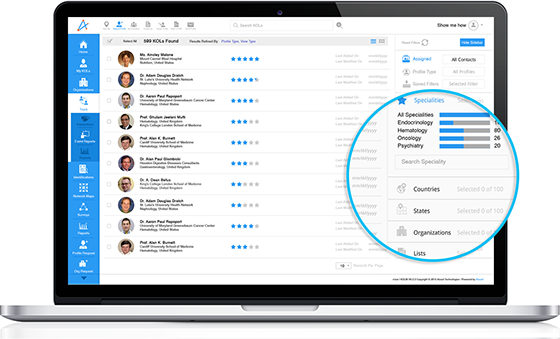
Creating and managing a tiered list of KOLs can be difficult for a lean, growing team. In such scenarios, teams can entrust these tasks to specialized KOL management firms that can help identify, prioritize, and manage expert relationships, allowing the team to focus on strategy and meaningful engagement.
Congress Planning: Maximize KOL Engagement Before, During, and After the Event
For a resource-constrained team, a single major congress in your indication is often the highest-leverage week of the year. A well-prepared two-person team can walk out of one congress having done more relationship-building than months of cold outreach would achieve.
However, the preparation gap is where teams lose the advantage. Walking in without knowing which sessions your target KOLs are presenting at, or which posters are relevant, means aiming at blind spots. Congress preparation should start at least a week ahead. It does not need to be elaborate. It needs to answer a few questions beforehand: who from your list is attending, and what are they presenting. That way you show up prepared and talk about what matters with KOLs.
This is one area where even lean teams benefit from structured support rather than manual searching through conference agendas by hand. Teams have started using konectar Conference Reports to pull together pre-congress intelligence and speaker mapping in a fraction of the time it would take to do it manually.
KOL Engagement Strategy: Build Strong, Consistent Relationships
A common mistake for lean teams is treating KOL engagement as one-off activities. They engage heavily before a congress or major readout, then go quiet for months. It can make the relationship feel transactional.
The alternative does not require more resources, just better spacing. A short, relevant touchpoint every six to eight weeks, tied to something genuinely useful to the expert rather than to your own news cycle, keeps a relationship warm without demanding significant time. This could be a piece of research relevant to their work, a short note on a regulatory development in their area, or simply following up on something they mentioned in your last conversation. The goal is not frequency. It is staying connected enough so that the relationship stays warm when you need to engage.
Building an Effective KOL Advisory Board
Lean teams sometimes create a formal advisory board too early, bringing in well-known experts before building real relationships with them. The meetings may be well-attended but often don't lead to useful input.
Building a board with the same familiar names does not guarantee useful input. What advisory boards need is experts with real, relevant experience. This means research into the right experts across relevant therapeutic areas is essential before the board is formed. This is where konectar can help, surfacing experts matched to the therapeutic area and program, so teams build boards around relevance and experience rather than name recognition alone.
KOL Relationship Management: Keep Track of Every Interaction and Follow-ups
Most resource-constrained teams have some version of a contact list: names, titles, institutions, maybe an email thread history. What is usually missing is relationship context: what was discussed last time, what the expert cares about, what the natural next step is.
After every meaningful interaction, whether a call, email, or congress conversation, write short notes on what was discussed and what to do next. Doing this consistently keeps important context from getting lost when people change roles or leave.
As teams grow, this context needs a system beyond one person's notes or inbox. konectar CRM keeps these details linked to each KOL’s profile, so anyone can quickly see the history and know what to do next.
Closing Thought
A KOL strategy built for a lean team isn’t about doing less. It is about being more focused, with every effort tied to a specific decision. The teams that do this well know why each KOL matters and what action they need to take with each relationship. Having the right system in place can make this much easier to manage without adding more manual work to the team. konectar, AI-Powered KOL Management Platform brings these activities into one place. If you’d like to see how this could fit into your team’s workflow, request a demo of konectar.
FAQs
- How many KOLs should an emerging biotech company track?
There is no fixed number. Focus on the KOLs who are most relevant to your current goals, and prioritize quality of engagement over the size of your list.
- How do we keep KOL relationships warm between congresses without a big budget?
Regular, relevant touchpoints work better than frequent outreach. Send occasional emails about relevant studies, publications, events, or industry developments to stay connected without taking much of the KOL’s time.
- When should you move from manual KOL management to structured support?
Manual tracking may work for a small, focused KOL list, but it becomes harder to manage as KOL relationships, interactions, and engagement activities grow. Structured support as offered by konectar helps keep everything organized, maintain relationship history, and reduce the time spent on manual tracking.
Read Next
HCP Engagement Solutions for Medical Affairs: Features, Use Cases, and Selection Criteria


Recommended