28-05-2026
From Regional to Global KOLs: How to Build a Tiered Engagement Model That Scales
Most life sciences teams have a KOL strategy. Far fewer have one that holds up when the product pipeline expands, geographies multiply, and the same shortlist of familiar names stops being enough.
- Why Most KOL Programs Stop Working at Scale
- The Four Tiers of KOL Engagement Explained
- What Makes KOL Tiered Models More Effective
- How to Scale a KOL Program from Regional to Global
- Where to Begin with a Tiered KOL Strategy
- Conclusion
- Frequently Asked Questions
Why Most KOL Programs Stop Working at Scale
Teams usually start with a shortlist of respected names in the therapeutic area, a few advisory boards, and MSL teams start engaging these KOLs. For a single market or an early-stage launch, that approach is perfectly functional. The problems surface later, as brand uptake plateaus. As programs grow, teams tend to over-invest in the same global names while the regional voices actually shaping local prescribing behavior go largely unnoticed.
What separates programs that scale from those that plateau is usually not effort. It is a structured tiered model that defines who your KOLs are, what role each plays, and what meaningful engagement looks like at every stage of the relationship.
The Four Tiers of KOL Engagement Explained
Most life sciences organisations structure their KOL universe across four tiers, each defined by the nature and reach of a person's scientific influence.
Tier 1: Global KOLs
These are the names that appear on global guidelines, chair sessions at major global congresses, and lead the pivotal trials that reshape clinical practice. Their influence is not confined to a single country or region. This tier is typically small and engagement here is about building genuine scientific partnership over time, not a one-time outreach.
At this tier, experts are engaged for advisory boards, co-authorship, congress faculty roles, and steering committees.
Tier 2: National KOLs
These experts carry significant weight within their country. They combine scientific output with active speaking or investigator roles, and they sit at the intersection of global evidence and national clinical practice. When a Tier 1 insight needs to land in a specific market, it often travels through these voices first.
At this tier, experts are engaged for national meetings, local advisory boards, MSL interactions, and speaker programs.
Tier 3: Regional KOLs
Often the most underestimated tier in early program design and the most operationally important at launch. These are authors, speakers, and investigators working at a regional level
the people who shape how evidence is understood and applied in the communities where prescribing decisions actually happen. At this tier, experts are engaged for regional meetings, educational programs, MSL visits, and local speaker initiatives.
Tier 4: Community practitioners
Private practice physicians, PAs, NPs, and patient advocacy representatives. They sit furthest from the global scientific conversation and closest to the patient. Their value is not in shaping guidelines but in signaling how a therapy is actually being received at ground level, which is intelligence that rarely makes its way back through formal channels. At this tier, engagement is for insight gathering, educational initiatives, and digital engagement programs.
What Makes KOL Tiered Models More Effective
Identify KOLs Based on Current Data
The most common failure point is that the initial shortlist comes from internal nominations, conference attendance, or sales relationships. That process carries recency bias, geographic blind spots, and a tendency to recycle the same names year after year.
A scalable identification process starts with who is publishing in your space right now, who is leading relevant trials, who holds the densest peer network in your target geography, and who is emerging as a new voice in the field. The KOLs who matter most for your next launch may not be the same ones who mattered for your last. Therapeutic areas move quickly. Identification needs to keep pace.
Differentiate KOL Engagement Strategy by Tier
Defining four tiers and then sending all of them the same MSL visit defeats the purpose entirely.
Tier 1 engagement is about scientific partnership. Co-developing research agendas, contributing to advisory discussions, building credibility over multiple interactions across multiple years. This is not a relationship you open with a standard outreach email.
Tier 2 engagement is about translation. These experts understand the global evidence. What they need from you is support in contextualising it for their national audience, their clinical society, their local guidelines process.
Tier 3 engagement is about presence. Showing up consistently in regional forums, supporting educational initiatives, and making sure your scientific narrative reaches the practitioners who are actively shaping local clinical behavior.
Tier 4 engagement is about listening. Community practitioners and patient advocates sit closest to real-world clinical experience. The insight they carry about how a therapy is actually being received, what barriers exist at ground level, and where unmet need still lives, rarely surfaces through formal channels. Structured engagement at this tier brings it into view.
Each tier offers something the others do not. A program that treats all four the same way captures very little of what any of them has to offer.
Centralise KOL Engagement Data Across Your Teams
Tiered programs break down operationally when engagement data is fragmented. This means your call reports are one system, advisory board records in another, congress interactions in someone's inbox. No one has a complete picture, and when team members change, continuity disappears entirely.
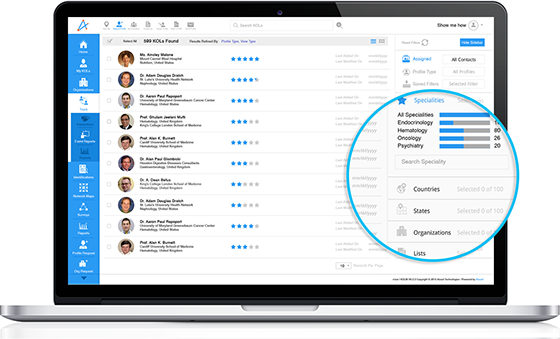
A centralized KOL management platform changes this by giving every team member a complete view of every relationship, right from every interaction and insight to activity logged against each expert. This is the operational foundation that makes tiered programs sustainable across geographies and over time.
Track KOL Tier Progression as Your Program Evolves
A healthy tiered program is not static. KOLs move through tiers as relationships develop and as the scientific landscape evolves. Tracking which Tier 4 voices are gaining influence, which Tier 2 experts are ready for global advisory roles, and where gaps are opening up, is both a measure of program health and a forward-looking investment signal.
Teams that track progression systematically also build a natural succession pipeline. When a Tier 1 KOL steps back, there is already a Tier 2 voice ready to step into that role.
How to Scale a KOL Program from Regional to Global
What changes at global scale is the complexity of identification, the coordination required across MSL teams, and the compliance infrastructure needed to manage engagements across different regulatory environments.
A leading cardiologist in Germany may have no visibility in Japan. Each market requires its own tiering exercise grounded in local data. Also what is standard practice in one market may require additional compliance review in another. A global program cannot apply a single engagement template across all geographies and expect it to hold.
Cross-functional alignment becomes a genuine operational requirement at this stage. Medical affairs, commercial, and clinical teams are often engaging KOLs in the same therapeutic area, sometimes without knowing it. Without a shared view of who those experts are and what contact has already taken place, the same KOL can receive overlapping or inconsistent outreach from different parts of the same organisation.
A CRM platform built for life sciences solves this, but only if it also supports data firewalling. Different teams have legitimate reasons to keep certain engagement records visible only to specific functions. The right platform allows cross-functional visibility where it is appropriate, and restricts it where compliance or confidentiality requires. Teams see what they need to see, and nothing they should not.
Where to Begin with a Tiered KOL Strategy
If your team is moving from an informal KOL approach to a structured tiered model, then you need to first define what each tier means for your specific therapeutic area and your current product lifecycle stage. Then agree on the criteria for tier placement. Map your existing KOL universe against those criteria and identify where the gaps are.
Once that framework is in place, the right platform makes a material difference. It will help you identify the right that you would not have found through manual research, tracking engagement across your full team, and giving every MSL a complete view of every relationship, regardless of who managed it before.
A tiered KOL engagement model, done well, does not just organise the relationships you already have. It surfaces the ones you did not know you were missing.
See how konectar helps you identify and tier KOLs for your specific program objectives. Request a demo
Conclusion
Most KOL programs do not bring the desired results because of poor relationships. They fail because the right experts were never identified in the first place. A tiered model fixes that by giving your team a clear view of who to engage and why.
FAQs
- What is a tiered KOL engagement model?
It’s a framework that segments your KOL universe by scientific influence and assigns a distinct engagement strategy to each tier based on the role that expert plays in your program.
- How many tiers should a KOL program have?
Most organisations work with four tiers, which includes global thought leaders, national experts, regional influencers, and community practitioners. KOLs in each tier are identified using different criteria and require a distinct engagement approach.
- How often should KOL tiers be reviewed?
At minimum once a year, and ahead of any new launch or major congress cycle as the scientific landscape shifts faster than most tiering models get updated.
- Why do KOL programs stop scaling?
That’s because KOL identification leans on past engagements and peer discussions rather than current research. Engagement also rarely differs meaningfully across tiers, and relationship history is too fragmented to give anyone a complete picture of engagement.
- How does technology support a tiered KOL program?
By centralising identification, profiling, and engagement tracking in one place, life sciences teams gain a complete view of every relationship regardless of who managed it before.
Read Next
Looking to strengthen your KOL engagement strategy? This one's worth a read:
Best Practices for HCP Engagement: Building Stronger Relationships Through Digital Tools


Recommended