03-04-2026
The Hidden Cost of Fragmented HCP Data in Medical Affairs Teams

Medical affairs teams are overwhelmed by data. Interaction logs, congress attendance records, medical insights. In short, the raw material of HCP intelligence is everywhere. Yet when a Medical Science Liaison needs a complete picture of a Key Opinion Leader before a critical meeting, they're left stitching together fragments from different systems.
In This Article
- Why Fragmentation Happens (and Why It Stays)
- The Real Cost Is Strategic, Not Operational
- What a Unified CRM Platform Actually Enables
- What If Your Entire HCP Ecosystem Lived in One Place? Meet konectar CRM
- FAQs
This is the paradox of modern medical affairs: the more data you generate, the harder it becomes to act on it. This is a challenge consistently echoed by the teams we engage with. 67% of medical affairs teams report spending more than 5 hours per week on manual data reconciliation, while 42% of HCP interactions are either logged incompletely, a compounding cost that erodes both efficiency and strategic visibility.
Why Fragmentation Happens (and Why It Stays)
The problem rarely starts with bad intentions. A team adopts a CRM for one use case. A colleague builds a master spreadsheet tracker for publication mapping. The compliance team maintains their own engagement log. Every department has its own "source of truth" — and none of them agree with each other.
Data silos in medical affairs aren't just a technical inconvenience. They're a strategic liability. Here's what fragmented HCP data actually costs you:
- Missed engagement opportunities — Without a unified view, MSLs duplicate outreach or, worse, miss follow-up windows entirely.
- Compliance exposure — Interaction data scattered across systems makes audit preparation slow, error-prone, and expensive.
- Slower planning — Teams can't identify white space or gaps when intel lives in a shared drive only one person updates.
- Leadership blind spots — Cross-functional reporting becomes guesswork when the underlying data isn't standardized or connected.
The Real Cost Is Strategic, Not Operational
It's tempting to frame fragmentation as an IT problem. But the downstream consequences land squarely in your medical strategy. When engagement history is incomplete, scientific exchange becomes transactional and field teams lose the ability to connect research to real-world practice change.
Medical affairs has evolved from a support function into a strategic driver of value. Fragmented data keeps teams operating like it's still the former. The gap between what MA teams know and what they can actually act on is where competitive differentiation is either built or lost.
What a Unified CRM Platform Actually Enables
When HCP engagement is managed through a unified CRM platform, teams gain a structured, end-to-end system to plan, execute, and track every interaction. From the first touchpoint to ongoing engagement, all activities are captured in one place — ensuring nothing is missed.
Teams can effectively plan engagements, log scientific interactions, and maintain a complete record of exchanges across channels. The platform also enables tracking of payments, contracts, and compliance-related activities, bringing greater transparency and control to HCP engagement.
Medical insights can be systematically captured and linked to interactions, allowing organizations to build a continuous feedback loop between field activities and strategic decision-making.
With all engagement data centralized, institutions gain visibility across teams, functions, and regions, ensuring consistency, improving coordination, and enabling more informed, compliant, and scalable HCP engagement.
What If Your Entire HCP Ecosystem Lived in One Place? — Meet konectar CRM
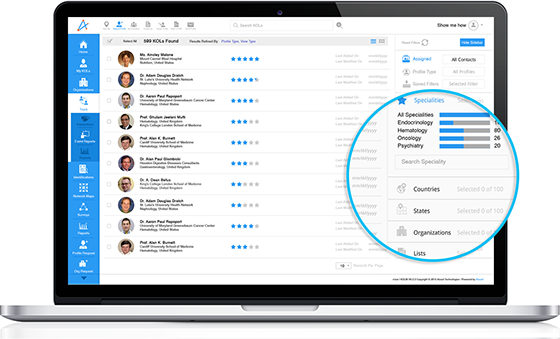
This question isn't hypothetical anymore. konectar CRM is not just another CRM layered on top of an existing tech stack. It's a single operating environment where every HCP interaction, insight, contract, and compliance record lives, connects, and informs the next action.
Imagine an MSL preparing for a KOL meeting. Instead of pulling from three systems, checking a shared spreadsheet, and emailing a colleague for the latest interaction notes, they open konectar and see everything: past interactions, the KOL's belief trajectory, sentiment shifts, planned objectives, and even payment history, all in one place. That's not a feature. That's a workflow transformation.
Beyond day-to-day engagement, konectar enables medical affairs teams to close the loop between field intelligence and strategic decision-making. Medical insights captured during interactions are systematically linked to the broader engagement record, meaning leadership can finally see what's happening on the ground and not weeks after the fact, but in real time.
When a KOL's sentiment shifts, when a therapy area conversation is gaining traction at a congress, that signal doesn't get lost in someone's notes. It feeds directly into planning.
For teams carrying compliance responsibility, konectar brings clarity to what has historically been a chaotic process. Contract timelines, payment records, engagement logs, all maintained within a single auditable system. No more scrambling before an audit. No more reconciling data across systems under deadline pressure. Compliance becomes a by-product of how you work, not an additional burden layered on top of it.
And for leadership, konectar delivers the cross-functional visibility that today's medical affairs strategy demands. Whether your teams are spread across regions, therapy areas, or partner organizations, the platform provides a consistent, standardized view of HCP engagement, making it possible to identify coverage gaps, measure relationship depth, and allocate resources based on actual data rather than assumption.
If your team is still navigating between systems, the cost of waiting is higher than you think. Book a personalized demo and discover what it looks like when your entire HCP ecosystem finally works as one!
FAQs
- What is the biggest challenge medical affairs teams face with HCP data today?
The core challenge is fragmentation, data exists across multiple systems, spreadsheets, and siloed platforms, making it nearly impossible to get a single, accurate view of any HCP relationship. Teams spend more time reconciling data than acting on it.
- Can konectar CRM integrate with our existing tools and workflows?
Yes. konectar CRM is built for easy customization and integration, allowing it to connect with your current systems and workflows without disrupting existing operations — so teams can adopt it without starting from scratch.
Read Next:
If you regularly participate in conferences, this article is worth your attention.
Top 5 Conference KPIs Every Medical Affairs Leader Should Watch


Recommended