20-04-2026
Pre-Launch KOL Strategy for Medical Device Companies: Building Scientific Credibility Before Market Entry

Two medical device companies launch similar products in the same therapeutic area. One achieves rapid clinical adoption. The other struggles to gain traction despite comparable clinical data. The difference is rarely the product.
In most cases, the key difference is how well each company develops its pre-launch KOL strategy.
Critical MedTech launch decisions are made before any device ships—in advisory boards, clinical discussions, conference meetings, and in influential clinicians’ minds.
A MedTech launch strategy should incorporate early KOL engagement, as scientific credibility is built progressively over time.
In this Article
- Pre-Launch KOL Strategy in Medical Device Determines Market Adoption
- Why KOL Dynamics in MedTech Are Fundamentally Different
- The KOL Landscape: Identifying the Right Voices
- 5 Steps to Building a High-Impact Pre-Launch KOL Strategy
- What Causes KOL Strategies to Fail
- Conclusion
- FAQs
Pre-Launch KOL Strategy Determines Market Adoption
When a respected surgeon or specialist speaks about a device much before the product is launched, peers listen. That is not marketing; it is earned trust. Yet many organisations begin KOL engagement too late. They wait until launch is imminent, then activate experts quickly. By that stage, they have already missed the critical window where credibility could have been formed.
The pre-launch KOL strategy is about building genuine scientific relationships that result in:
- Early familiarity with the technology
- Contribution to clinical evidence generation
- Publication and presentation activity
- Peer-level advocacy
Clinicians deciding whether to adopt your device are influenced by the depth of pre-launch engagement and credibility achieved via early, genuine scientific relationships.
Why KOL Dynamics in MedTech Are Fundamentally Different
KOL engagement exists across life sciences, but in medical devices, the dynamics are structurally different and more complex.
In pharmaceuticals, KOL influence is largely educational. Experts shape prescribing behaviour through publications, conferences, and peer discussions. The prescribing decision is ultimately made by an individual physician.
In MedTech, adoption is multi-layered and operational, requiring alignment across several dimensions:
Procedural Dependency
Devices often require new techniques. Adoption depends on clinicians who can train others, making clinical educators and proctors essential to scaling usage.
Institutional Procurement
Before a device reaches clinicians, it must pass through hospital value analysis committees. Health economics–oriented KOLs who can articulate cost-effectiveness are critical and often overlooked.
Multi-Specialty Complexity
Many devices span specialties. A structural heart device, for example, may require alignment across cardiology, cardiac surgery, and imaging. This demands broader stakeholder mapping and coordination.
The KOL Landscape: Identifying the Right Voices
KOL strategies in MedTech must be tiered by role, not just influence. Scientific leaders and educators each shape adoption differently and require distinct engagement models. A strong pre-launch strategy identifies multiple categories of stakeholders:
Global Scientific Leaders
A small group of top researchers whose work shapes clinical thinking, guidelines, and trial design.
National KOLs
High-volume practitioners with strong domestic networks and regular presence at national conferences.
Regional and Local Influencers
Clinicians who drive adoption within hospital systems and geographic clusters. Often underestimated, but critical for real-world uptake.
Clinical Educators and Proctors
Specialists who train peers on procedural techniques are especially important for devices with a learning curve.
Digital Opinion Leaders (DOLs)
DOLs are clinicians with strong engagement on digital platforms who can shape peer perception rapidly, even without extensive publication records.
5 Steps to Building a High-Impact KOL Engagement Roadmap
Effective KOL identification goes beyond surface-level influence. The goal should be to have a role-based, and geography-specific KOL ecosystem, not a static list of names. Here are 5 key steps to building a high-impact pre-launch KOL strategy:
Step 1: Build Deep, Actionable KOL Profiles
KOL identification is only the starting point. Relevance comes from understanding each KOL in depth. A meaningful KOL profile is a structured view of:
- Research focus and publication trajectory
- Conference activity and speaking patterns
- Institutional affiliations and clinical volume
- Collaboration networks and influence pathways
- Digital presence and engagement behavior
Step 2: Map Influence Networks
Influence in MedTech is network-driven, and KOL mapping provides visibility into:
- Central nodes of influence across specialties and geographies
- Relationships between collaborators and institutions
- Emerging KOLs gaining traction
- Connections to guideline bodies, payers, and decision-makers
Step 3: Engage Early with Structure and Intent
Pre-launch KOL engagement in MedTech must be both strategic and compliant. The objective is not promotion, but scientific collaboration. Effective KOL engagement includes:
- Advisory board participation to inform design and clinical use
- Publication planning aligned with existing research landscapes
- Investigator involvement in clinical trials and registries
- Development of educational and training content
Step 4: Follow a Structured KOL Engagement Roadmap
Knowing who your KOLs are is only the beginning. Here's a practical timeline that leading MedTech companies use to build authentic, compliant scientific relationships before market entry.
- Well in advance of launch: Use konectar to map clinical experts by tier, geography, and role.
- Early in the pre-launch phase: Identify global leaders and national KOLs with genuine interest in your device's unmet need. Share early data and seek input on study design and endpoint selection.
- Mid pre-launch phase: Work with clinical educators and proctors to co-develop training curricula, technique videos, and case-based modules.
- A few months before launch: Secure abstracts and podium slots at key society meetings where your KOLs take the stage as genuine clinical voices.
- Approaching launch: Deploy global scientific leaders as national voices, regional KOLs as institutional champions, and local influencers as first-referral educators.
Step 5: Build Infrastructure for Sustainable KOL Management
Execution at scale requires infrastructure. Many organizations still rely on fragmented spreadsheets or generic CRM tools to log KOL interactions, medical insights, and contract details, resulting in lost context, inconsistent engagement, and poor visibility across teams.
A purpose-built KOL CRM gives your team:
- Centralized profiles and complete engagement history
- Structured tracking of interactions, follow-ups, and medical insights
- Compliance-ready documentation across all activities
- Real-time visibility into engagement gaps and activity levels
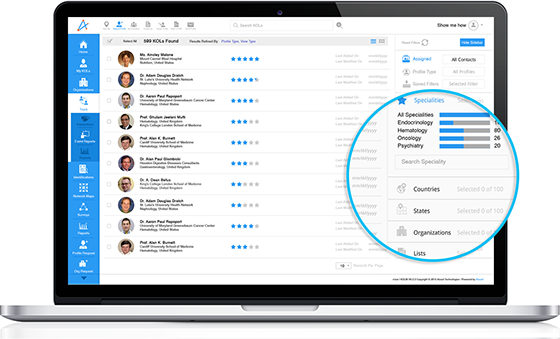
konectar is built precisely for this. It provides a unified, continuously updated view of every expert relationship, enabling teams to execute engagement seamlessly and coordinate across medical affairs, marketing, and commercial functions globally. [Request a demo]
What Causes KOL Strategies to Fail
The failure modes are remarkably consistent across companies. Teams build relationships with the same set of KOLs that everyone else in their space uses and arrive at launch with no differentiated scientific voice. Others engage too late, leaving less time to build meaningful relationships.
Some conflate influence with fame and neglect regional and local clinicians. The most common thread across all of these failures is building transactional relationships rather than genuine scientific ones.
konectar addresses the identification challenge directly, ensuring your team focuses on the right experts at the right time. While relationship quality ultimately depends on human engagement, it begins with knowing exactly who to engage and why.
Conclusion
The difference between slow adoption and rapid market traction is rarely the product itself. It is the strength of the clinical network behind it.
Organizations that invest early in identifying, mapping, and engaging the right clinicians build a foundation of scientific credibility. Because beyond commercial outcomes, the KOL strategy directly impacts patient care.
A well-executed MedTech launch strategy ensures that innovation reaches patients through prepared, informed, and confident clinicians.
FAQs
- When should KOL engagement begin?
Ideally, 12–18 months before device launch, though earlier engagement (up to 24–30 months) provides a stronger long-term impact.
- What is the difference between KOL identification and mapping?
KOL identification focuses on selecting the right experts that match your objectives. Mapping analyzes how those experts connect and influence each other.
- How can companies stay compliant during pre-launch engagement?
By focusing on scientific exchange, advisory input, and disease-state education, while avoiding promotional messaging and involving compliance teams early.
- What should a KOL management platform provide?
Centralized KOL data, capability with engagement tracking, segmentation, cross-functional visibility, and actionable insights designed to drive healthcare relationships.
- Why is KOL strategy different in MedTech versus pharma?
MedTech KOL strategy is more complex because the device adoption depends on various factors, including procedures, training, and hospital approvals, not just prescriptions. It requires alignment across clinicians, institutions, and multiple specialties.
Read Next:
Have you considered tracking how often and where your company stands compared to competitors? This article is worth reading - Analyzing MedTech Companies’ Share of Voice with konectar SSoV


Recommended