03-04-2026
How to Build High-Impact Advisory Boards Using Real-World Data
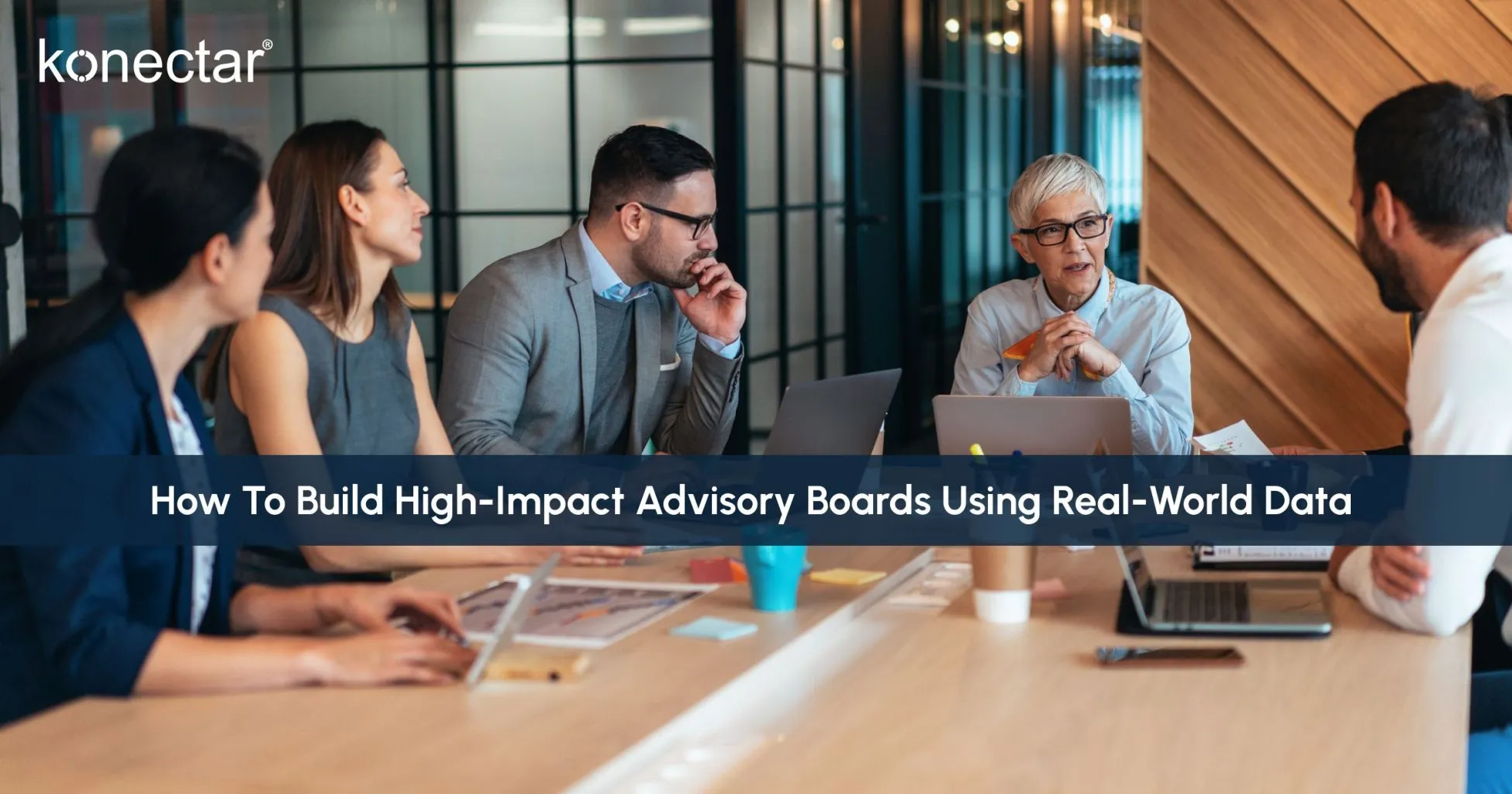
For life sciences organisations operating at scale, advisory boards are not a routine engagement activity, they are a strategic lever. The right board brings focused scientific expertise to R&D decisions, portfolio strategy, and beyond, directly accelerating what the organisation is trying to achieve. That makes expert selection not a formality, but the foundation. A board assembled with familiar names rather than the right ones quietly consumes budget, bandwidth, and relationship capital, returning far less than the investment deserves.
In this article
- The Problem With How Advisory Boards Are Built Today
- What High-Impact Advisory Board Selection Actually Looks Like
- How konectar Supports Advisory Board Formation
- Building the Advisory Board Your Strategy Deserves
- FAQs
Traditional KOL selection metrics such as congress presence, publication volume, etc., remain relevant reference points. However, the problem is not what teams are looking at, it is how they are doing it. Aggregating these inputs manually, from disconnected systems and disparate sources, is time-consuming and prone to gaps that only becomes evident after a board has already been convened. The organisations pulling ahead have stopped treating KOL identification as a relationship exercise and started treating it as an intelligence capability.
The Problem With How Advisory Boards Are Built Today
What we hear consistently from teams reflects a broader pattern. Three in five medical affairs leaders feel the boards lack the right mix of specialties and perspectives. And nearly half of all insights generated in the meetings never make it into medical strategy at all.
Six Strategic Gaps in Advisory Board Formation
- Subjective KOL Selection
Teams default to familiar names, the same voices. Expert selection becomes a reflection of network proximity rather than strategic fit. The result is a board that is comfortable to convene but rarely challenging enough to be genuinely useful.
- Incomplete Scientific Profiles
Publication history alone does not reveal KOLs’ current research priorities, evolving clinical positions, or the peer conversations shaping their perspective. Decisions made on static, retrospective data produce selections that were relevant twelve months ago, not necessarily now.
- No Alignment to Board Objectives
Early evidence generation, market access strategy, and label expansion each demand a fundamentally different scientific profile. When selection criteria are not anchored to a specific board mandate, organisations assemble generalist panels where strategic depth is needed and pay for expertise that does not move the needle.
- Fragmented Engagement History
Once a KOL is identified as a potential engagement target, interactions begin accumulating across different systems about their scientific positioning. By the time that same KOL is formally considered for an advisory board, those early signals are scattered across the organisation with no single owner. The selection team then pieces together a relationship picture that should already exist.
- Post-Meeting Data Loss
Advisory board meetings generate significant scientific insight but most of it never makes it into strategy. Summaries circulate, notes get archived, and the conversation loses momentum. The questions that should have shaped the next phase of planning simply resurface at the next meeting.
- Strong Scientific Voices Are Overlooked
Organisations naturally gravitate toward geographies and networks where established relationships exist. This creates a structural bias that leaves critical scientific voices and those driving real-world practice change in communities consistently remain outside the strategy.
"An advisory board, built with intention and the right intelligence, is one of the most powerful strategic assets a medical affairs team can deploy. The question is never whether to invest in one; it is whether the selection behind it is strong enough to honour that investment."
What High-Impact Advisory Board Selection Actually Looks Like
Every advisory board should begin with one question: what does this board need to deliver? The answer defines the expertise required, the perspectives that should belong in the room, and ultimately every name on the list. A board convened to stress-test trial design demands a different set of voices than one focused on a post-launch board for real-world evidence generation. The mandate comes first. The selection follows. Here is what that process should look like in practice:
- Define the board's strategic mandate first
- Map required expertise
- Evaluate scientific influence holistically
- Assess current research trajectory
- Factor in peer network strength
- Review prior engagement history
- Ensure diversity of perspective
How konectar Supports Advisory Board Formation
konectar is designed to support the full arc of a KOL relationship right from identification, scientific profiling, engagement planning, and managing those relationships at scale. Every engagement is connected to the broader relationship history. Every team member across functions, geographies, and therapeutic areas is working from the same complete, real-time picture. Compliance and firewall controls are embedded, so teams can move with both speed and confidence.
What konectar ultimately delivers is not a better database. It is end-to-end visibility across every KOL relationship your organisation holds. And with that visibility, the gap between strategic ambition and operational reality finally closes. Medical affairs teams gain not just a clearer picture of their KOL landscape but the infrastructure to act on it, consistently and at scale.
Building the Advisory Board Your Strategy Deserves
Advisory boards are too strategically important and too resource-intensive to be built on familiarity and instinct. The tools now exist to do this better, and the teams using them are moving ahead.
Book a demo with us and discover how the right intelligence can transform the way you identify KOLs, build advisory boards, and drive scientific strategy forward.
FAQs
- What is a KOL advisory board and why does it matter for life sciences companies?
A KOL advisory board is a structured forum where scientific experts are selected for their clinical, research, or therapeutic area expertise. They provide strategic input to life sciences companies. These boards inform clinical trial design, evidence generation strategy, market access planning, and medical communications. When built well, they are among the highest-value activities in medical affairs because their insights directly shape strategy rather than simply validate decisions already made.
- How should life sciences teams define KOL selection criteria for different advisory board objectives?
Selection criteria should be anchored entirely to the board's strategic mandate. Different objectives demand fundamentally different scientific profiles. The organisations that define that mandate with precision before any name is discussed are the ones that build boards capable of delivering genuine strategic value.
- How does konectar help medical affairs teams build better advisory boards?
konectar is built to help teams manage the full KOL lifecycle, beginning with identification and scientific profiling, and extending through every stage of engagement and further relationship management. The platform is designed to grow alongside those relationships, equipping teams with the insights, tools, and workflows needed to engage the right experts, at the right time.
- How many KOLs should be on a pharmaceutical advisory board?
High-impact advisory boards in pharma aren't defined by size, they are defined by composition. A smaller, focused board can drive sharper strategic thinking in early-phase discussions, while a broader group brings value when diverse clinical perspectives are needed. What matters most is getting the right mix of specialty, geography, practice setting, and research focus in the room. The best boards aren't the biggest, they are the most purposefully built.


Recommended