30-07-2026
How to Choose the Right CRM for Life Sciences Organizations
Choosing a CRM for life sciences teams once meant picking a system that stores contacts, tracks interactions, and generates a few reports for leadership. Today that calculus no longer holds. Medical Affairs, Commercial, and Field teams now manage increasingly complex stakeholder ecosystems, from Key Opinion Leaders and investigators to advocacy groups and cross-functional internal teams.
Today the decision to invest in a CRM has become less about "can it store our contacts" and more about "can it actually support how our teams think and work."
In this article:
- A Data Model Built for Life Sciences, Not Retrofitted for It
- Integration Depth, Not Integration Claims
- Usability That Matches How Field and Medical Affairs Teams Actually Work
- Scalability Across Regions
- Cost Benefit Analysis
- FAQs
Here are a few points worth considering when investing in a CRM.
A Data Model Built for Life Sciences, Not Retrofitted for It
Generic CRMs are designed around sales pipelines, focusing on leads, opportunities, and conversion metrics. Life sciences relationships don't fit neatly into that framework. The most effective CRMs are purpose-built for life sciences, with native data models that capture attributes such as therapeutic areas, institutional affiliations, clinical trial involvement, publications, and scientific expertise, rather than relying on repurposed sales fields that fail to reflect the complexity of scientific engagement.
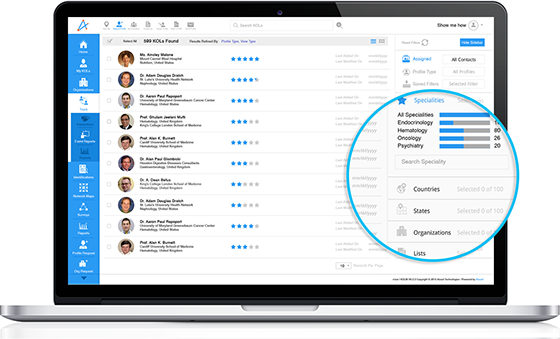
Discover how konectar CRM can streamline HCP engagement and relationship management.
Integration Depth, Not Integration Claims
Nearly every CRM vendor claims their platform "integrates with everything." The more important question is how seamlessly those integrations work. Can the CRM synchronise bidirectionally with legacy systems, giving MSLs access to both historical and real-time updates without switching between applications? The depth of integration ultimately determines whether Medical Affairs and Commercial teams can focus on scientific engagement and strategic decision-making or spend valuable time manually reconciling data across disconnected systems.
Usability That Matches How Field and Medical Affairs Teams Actually Work
Field and Medical Affairs teams are mobile, time-constrained, and often logging notes between meetings. The interface needs to reflect that reality. If logging a KOL interaction takes seven clicks and nine dropdown menus, reps will simply stop doing it consistently, leading to incomplete records and declining data quality over time.
Scalability Across Regions
The best life sciences CRM may work well for a single therapeutic area in one region but may not always support multiple regional teams. Data structures that seemed sufficient at a smaller scale often break down under multi-region complexity. Before committing, it is worth asking the vendor how the system has performed for organizations of similar scale and complexity.
Cost Benefit Analysis
A CRM should be evaluated based on the return on investment (ROI) it delivers, not just its implementation cost. A purpose-built life sciences CRM generates ROI by accelerating KOL identification, improving field productivity, supporting more informed decision-making, and stronger HCP engagement. The greater the time saved and the better the business outcomes achieved, the higher the long-term return on the investment.
Life Sciences CRM Evaluation: A Snapshot
Criteria | What to Look For |
|---|---|
Data model | Fields designed around life sciences workflows, not relabeled sales fields |
Integration | Bidirectional, real-time sync with legacy systems |
Usability | Minimal steps to log an interaction, track engagement, built for time-constrained field use |
Scalability | Proven performance across multiple regions and therapeutic areas |
Cross-functional fit | A single, shared system that Medical Affairs, Commercial, and Field teams can all use, eliminating duplicate data entry and separate workarounds |
Cost-benefit Analysis | Demonstrable ROI through productivity gains, efficiency, and improved business outcomes. |
What Should Ultimately Drive Your CRM Decision
The decision of how to choose a life sciences CRM should begin with a clear understanding of your team’s priorities. If your focus is scientific engagement, KOL relationship management, cross-functional collaboration, or operational efficiency, the platform should be evaluated against those specific goals. The right CRM is one that aligns with your teams' workflows, supports their day-to-day activities, and delivers measurable business value.
Frequently Asked Questions
- How is a life sciences CRM software different from a general-purpose CRM?
General-purpose CRMs are built around sales pipelines, while life sciences organizations need data models built around KOL relationships tracking, and scientific engagement, which most generic systems are not designed to support.
- How important is integration depth when choosing a CRM?
It is one of the most important and most overlooked factors. Bidirectional, real-time integration with legacy systems prevents data silos, while one-way integrations tend to create more manual reconciliation work over time.
- What is the biggest reason CRM adoption fails in life sciences organizations?
Usability friction is the most common cause. If logging an interaction takes too many steps, Field and Medical Affairs teams stop doing it consistently, and data quality erodes from the inside out.
- How does konectar CRM support life sciences teams?
konectar CRM is built around the mobility and cross-functional needs of life sciences organizations, with a user-friendly interface for logging interactions, alongside features that enable effective KOL and HCP relationship management across Medical Affairs, Commercial, and Field teams.
Read Next:
Discover a structured approach to finding and prioritizing the right KOLs. How to Identify and Map the Most Influential KOLs in Your Therapeutic Area


Recommended