Social Media Analytics: Tracking Scientific
Share of Voice in the Digital Space
Social media analytics helps life sciences
teams understand who is shaping scientific
conversations online and where their
organization stands within a therapeutic
area. It provides visibility into social media share of voice
and competitive positioning, without the
burden of manual tracking.
Monday, July 6, 2026
What is Social Media Analytics in Life Sciences?
Social Media Analytics in life sciences is the process
of monitoring, analyzing, and interpreting scientific conversations across digital channels to understand how research, therapeutic
topics, and healthcare professionals are influencing the
broader scientific landscape.
Social media analytics gives life sciences teams a clear
read on their brand’s impact across social media and
digital channels. Rather than treating social platforms
as noise to be filtered manually, teams get a clear view
of where scientific opinion is forming and how their own
presence fits into it.
At its core, this is about understanding real influence
within a specific clinical or scientific context,
interpreted by experts who know the difference between
genuine authority and surface-level reach.
Scientific Influence Has Expanded Beyond
Traditional Channels
Scientific influence has traditionally
been measured through publications,
citations, congress presentations, and participation in advisory boards. While
these indicators remain essential, they no
longer provide a complete picture.
Researchers now discuss newly published studies online
within hours of publication.
Physicians debate treatment pathways through
professional communities. Medical societies share
guideline updates across digital channels, while Digital Opinion Leaders interpret complex evidence for thousands of healthcare
professionals worldwide.
These discussions often continue long after conferences have ended, extending the reach and impact of scientific findings.
For organizations, understanding these conversations
provides valuable context that complements traditional
scientific metrics rather than replacing them.
The Rise of Digital Opinion Leaders (DOLs)
Alongside traditional Key Opinion Leaders
(KOLs), Digital Opinion Leaders have become influential
voices within the scientific community.
DOLs establish credibility by consistently
sharing evidence-based content, interpreting research, participating in professional
discussions, and engaging with healthcare professionals
across digital platforms.
Their influence extends beyond audience size.
Many become trusted sources because they
simplify complex science, respond quickly to
emerging evidence, and actively contribute to
ongoing clinical conversations.
Identifying these individuals early enables
organizations to strengthen scientific
engagement, develop meaningful collaborations,
and better understand how therapeutic discussions
evolve over time.
Activity alone does not indicate influence. An
organization may post regularly across channels yet
remain underrepresented in the conversations that
matter, while competitors with sharper engagement
strategies capture more attention within their
therapeutic areas. This is why social media analytics
has become an important metric.
Social media analytics helps organizations understand
not only where they stand today but also how their
position changes as the social landscape evolves.
The Risk of Staying Unmonitored
Organizations that leave this space unmonitored aren't
just missing valuable insights—they are operating with a
critical blind spot. Changes in stakeholder sentiment,
emerging scientific discussions, and competitive movements
often go unnoticed until they've already influenced perception,
strategy, or decision-making.
The impact is rarely immediate. Instead, it builds over
time. Research priorities drift, opportunities to engage
key stakeholders are missed, competitors strengthen
their position, and an organization's scientific influence gradually declines. By the time these changes become visible,
recovering lost ground is often far more difficult and costly
than recognizing the signals early.
Social Media Analytics vs. Traditional Social
Listening
The two are often confused, but they serve different
purposes.
Traditional social listening, tracks brand mentions,
general sentiment, and share of voice in an advertising
or consumer context. It is built to answer questions
like "what are people saying about our brand" and "how
does our campaign compare to a competitor's."
Social media analytics for life sciences is built around
a different question: who is shaping scientific opinion
in this therapeutic area, and how is that opinion moving?
It helps organizations understand their Scientific Share
of Voice (SSoV) by revealing their standing within relevant
scientific conversations.
What Social Media Analytics Reveals
1. A ready view of who is genuinely shaping
conversation in a therapeutic area.
2. A clear sense of where an organization stands
against competitors, already researched and
ready to act on.
3. An early alert to shifts and emerging themes,
before they become common knowledge.
4. One consolidated view across multiple social
media channels and professional platforms.
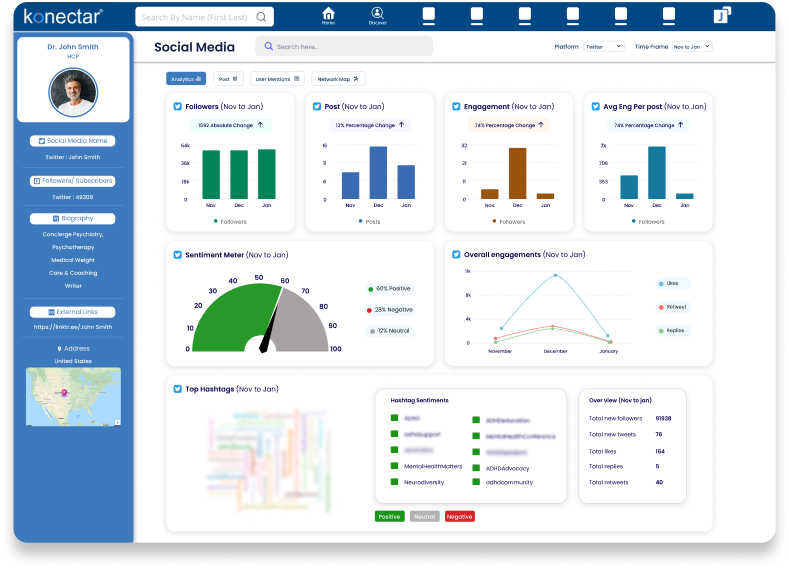
konectar Social Media Analytics
konectar Social Media Analytics gives teams a clear, continuous
view into the digital scientific conversation shaping
their therapeutic area. It helps teams track competitive
messaging and identify who is genuinely driving that
conversation, not just who appears to have the loudest
presence. This enables teams to benchmark their digital
presence against competitors, identify emerging opportunities,
and prioritize strategic areas of focus, well before
these trends become apparent across the industry.
Social Media Analytics in life sciences is
the process of monitoring and analyzing
scientific conversations of a brand across
digital channels to understand its
Scientific Share of Voice, benchmark presence against competitors, and
gain insights that support strategic decision-making.
Unlike traditional social listening, it
focuses on scientific influence, therapeutic area conversations, and competitive
intelligence rather than brand mentions alone.
Medical Affairs, Commercial, Competitive Intelligence, and Strategy
teams can all benefit from these insights.
konectar Social Media Analytics provides
insights into scientific conversations,
digital influence, competitive positioning,
and emerging trends within a therapeutic
area.
Monitoring Scientific Share of Voice helps
organizations measure their digital
influence, identify opportunities early, and
make more informed strategic decisions.

Social Media Analytics vs. Traditional Social Listening