
KOL Management in Life Sciences: A Complete Guide for Pharma, Biotech, Medtech, and Diagnostics Teams
This comprehensive guide explores the fundamentals of KOL management for pharmaceutical, biotechnology, medical device, and diagnostics organizations. Learn how to identify and prioritize key opinion leaders, build meaningful scientific relationships, and maximize the value of your KOL engagement.
Friday, June 12, 2026

What is KOL Management?
Types of KOLs in Life Sciences
Life sciences companies work with different types of opinion leaders depending on the objective, the therapeutic area, and the stage of the product lifecycle.
Global KOLs
Global KOLs are the most recognized experts in their field. They publish in top-tier journals, present at international congresses, and often contribute to shaping global clinical guidelines. Engaging a global KOL is high-value but requires significant relationship investment and long-term planning.
Regional KOLs
Regional KOLs have strong influence within a specific geography or market. They may not have the same international profile as global KOLs, but they carry significant weight among local prescribers, institutions, and medical communities. For market access and launch strategies, regional KOLs are often more operationally relevant.
Digital Opinion Leaders (DOLs)
DOLs are healthcare professionals who build and exercise their influence primarily through digital channels such as social media platforms, podcasts, and online communities. They may not have a traditional academic profile, but their ability to reach and engage peers at scale makes them increasingly important in modern medical affairs strategy. DOLs complement KOL engagement, they do not replace it.
Emerging KOLs / Rising Stars
Emerging KOLs are early to mid-career professionals who are building influence in their therapeutic area. They publish, present, and engage actively but have not yet reached senior KOL status. Identifying and nurturing emerging KOLs early gives life sciences companies a long-term relationship advantage as these experts grow in influence.
How Pharma, Biotech, Medtech, and Diagnostics Use KOL Management Differently
KOL management looks different depending on the type of life sciences company. The underlying goal is the same to build credible relationships with the right experts. However, the objectives, the stakeholders, and the engagement models vary across verticals.

Pharma
Pharma teams use KOL management to support HCP education, influence formulary access decisions , and drive post-launch adoption. KOLs here play a central role in shaping prescriber behavior and supporting payer conversations through their clinical credibility.
Biotech
For biotech companies, KOL relationships are built early and tied closely to clinical development. KOLs serve as principal investigators, scientific advisors, and credibility anchors that help emerging therapies gain traction in the medical community.
Medtech
Medtech companies engage KOLs to support device training, drive procedural adoption, and generate real-world evidence. Clinical champions who use and advocate for a device within their institutions are often the most valuable relationships in this space.
Diagnostics
In diagnostics, KOL strategy centers on developing lab champions and securing inclusion in clinical guidelines and testing protocols. Experts who influence how and when a diagnostic test is used can determine market penetration more than any commercial effort.
Medical Affairs
Medical Affairs is the primary driver of KOL engagement. They engage KOLs for advisory board formation , steering committees, speaker programs, and scientific exchange. Their focus is on building long-term relationships rooted in scientific dialogue rather than commercial intent.
Commercial Teams
Commercial teams use KOL relationships to gather market insights, support HCP segmentation, and prepare for product launches. KOLs help commercial teams understand how a therapy is perceived in the market and where the gaps in adoption exist.
Clinical Teams
Clinical teams engage KOLs as principal investigators, co-investigators, and site champions. They build KOL relationships to identify trial sites, strengthen site-level connections, and support clinical program execution from study startup through data generation.
Other Teams
Other life sciences teams engage KOLs to build and support disease awareness initiatives, develop educational content, and strengthen scientific credibility among healthcare professionals.
Identification
Once a team defines their engagement objective, the first step is identifying the right KOLs, those who align with the specific therapeutic area, scientific focus, or strategic goal at hand. The aim is to build a qualified list, not a long one.
Profiling
Profiling should cover KOLs’ professional expertise and activities. A strong profile gives MSLs and Medical Affairs teams the clarity to focus on experts who are genuinely relevant to their objectives.
Mapping
KOL mapping involves analyzing how healthcare professionals are connected to other experts, their position within institutional and geographic networks, and how influence flows across a therapeutic area.
KOL Tiering
KOL Tiering is about ranking KOLs based on their expertise, professional activities and more. The scoring may vary by objective. Those building scientific advocacy prioritizes publications, while one looking to engage PIs or Co-PIs considers trial involvement.
Engagement Planning
Once the right KOLs are identified and tiered, teams build engagement plans tailored to each expert. This includes advisory boards, speaker programs, research collaborations, and education initiatives. The best engagement plans are built around the KOL's scientific interests, not just the company's commercial calendar.
Relationship Management
KOL relationships need to be maintained over time. This means tracking every interaction, capturing insights from MSL field visits, and ensuring continuity even when team members change. Relationship management is what separates a one-time engagement from a long-term scientific partnership.
Impact Measurement
One should also keep measuring what the engagement has achieved. Teams measure engagement quality, scientific share of voice, advocacy outcomes, and KOL sentiment over time. This helps turn relationship activity into strategic intelligence that informs the next planning cycle.
Publication Activity
Look for KOLs with a strong publication record, as it reflects their scientific credibility and subject-matter expertise.
Clinical Trial Participation
Consider KOLs with clinical trial expertise, as it can demonstrate their practical experience and involvement in clinical research.
Speaking Engagements
Check for KOLs who frequently participate in congresses and scientific meetings, as this reflects their recognition and involvement in scientific discussions.
Social and Digital Influence
Find DOLs with a strong digital presence. This indicates their ability to engage with and contribute to conversations among broader professional audiences.
Peer Nominations
Recommendations from respected peers can provide valuable insight into a KOL’s professional reputation and influence within the field.
Industry Engagement and Grant History
KOLs involved in advisory roles, and other industry initiatives can offer broader experience and engagement within the field.
Network Mapping
KOLs don't operate in isolation. Network mapping visualizes how leaders connect to each other, helping teams identify relationship clusters and white-space opportunities.
Geographic Mapping
Geographic mapping surfaces where scientific leadership is concentrated by region, country, or market, so field teams can prioritize territory planning.
Influence Mapping
Influence mapping scores leaders based on specific criteria and allows your team to know who actually shapes clinical opinion.
The Significance of KOL Engagement Across the Product Lifecycle
| Stage | KOL Role |
|---|---|
| Pre-clinical / Early Development | Scientific advisory boards, grant alignment, early research partnerships |
| Evidence Generation | Study design input, investigator relationships, data interpretation |
| Pre-launch | Guideline shaping, congress presence, peer-to-peer education |
| Launch | Speaker programs, HCP outreach,real-world evidence partnerships |
| Post-launch | Long-term advocacy, lifecycle extension studies, label expansion |
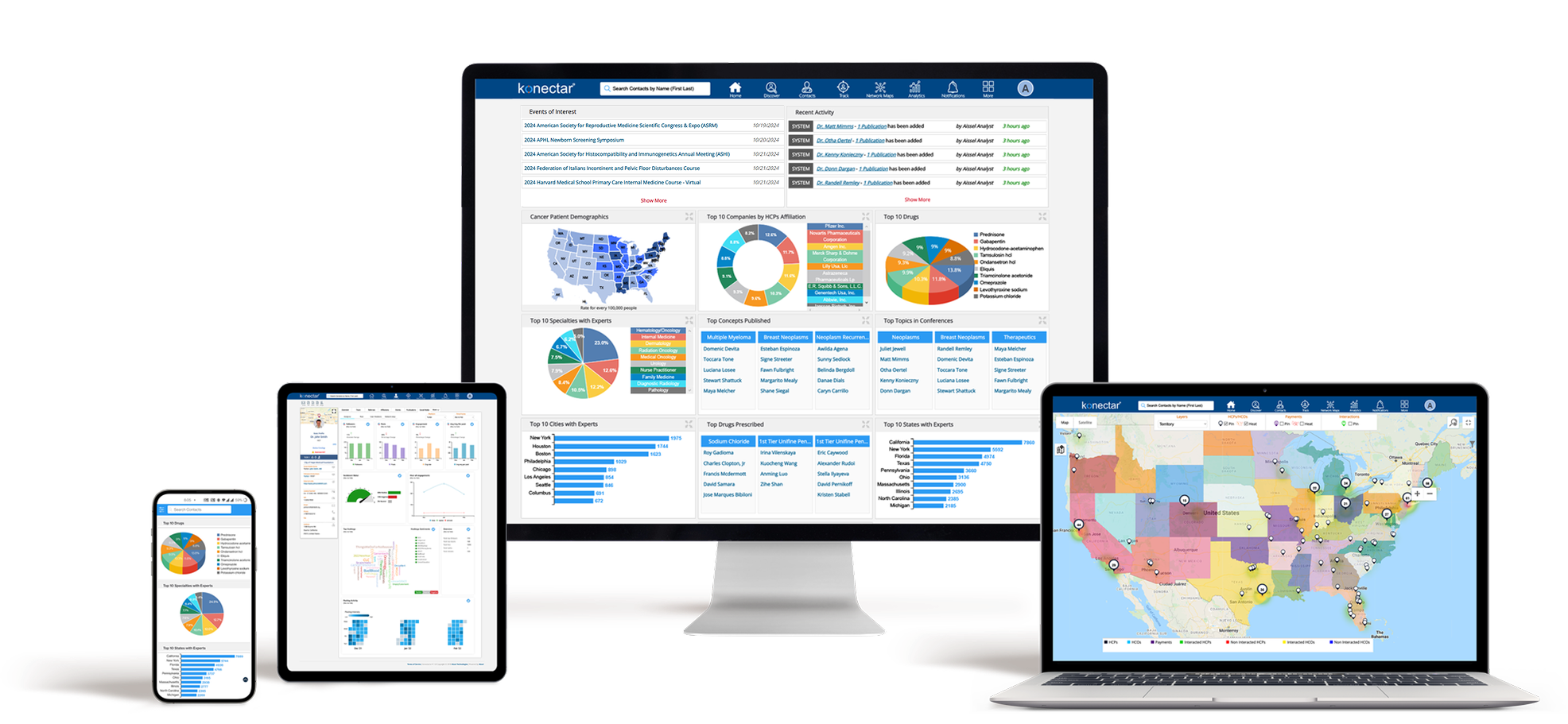
The platform should consolidate publications, clinical trials, speaking engagements, affiliations, and past interactions into a unified expert profile, providing teams with a complete view of each KOL.
Teams should be able to identify experts using filters such as therapeutic area, geography, institution, publications, and clinical trials. AI-powered discovery can help uncover relevant experts beyond traditional search methods.
Look for capabilities that centralize KOL interactions, support engagement tracking, manage contracts and consents, and capture sentiment, advocacy, and key insights over time.
The platform should enable Medical Affairs, Commercial, Clinical, and Market Access teams to collaborate from a shared KOL view while maintaining appropriate access controls and information firewalls.
Robust analytics should help teams measure engagement effectiveness, advocacy trends, scientific influence, and KOL sentiment to support strategic decision-making.
The platform should support compliant engagement workflows, maintain audit trails, and provide visibility into potential compliance risks.
KOL management is the process of identifying, profiling, engaging, and managing relationships with Key Opinion Leaders (KOLs) to support scientific, clinical, and commercial objectives.
KOL management helps life sciences organizations build scientific credibility, gather expert insights, support evidence generation, and strengthen engagement with the medical community.
KOLs are identified using indicators such as publications, clinical trial participation, industry collaborations, etc,.
KOL profiling is the process of building a comprehensive view of an expert, including their professional expertise, and engagement activities.
KOL mapping helps organizations understand how experts are connected through professional networks within a therapeutic area.
KOL tiering is the process of ranking experts based on factors such as influence, expertise, and strategic relevance to business objectives.
A KOL primarily influences through scientific expertise and clinical leadership, while a DOL (Digital Opinion Leader) builds influence through digital channels such as social media, webinars, podcasts, and online communities.
Medical Affairs teams use KOL management to support scientific exchange, advisory boards, speaker programs, evidence generation, and long-term relationship building.
A KOL management platform is software that helps life sciences teams identify, profile, map, engage, and analyze relationships with Key Opinion Leaders.
Medical Affairs, MSLs (Medical Science Liaisons), Commercial, Clinical, and many other life sciences teams use KOL management software to support expert engagement and decision-making.