
KOL Tiering Best Practices: A Guide to Smarter Expert Engagement
Identifying key opinion leaders is only the first step. The real challenge is knowing which experts to prioritize and which initiatives they are right for. KOL (Key Opinion Leader) tiering gives life sciences teams a data-backed framework to engage the right experts at the right time.
Friday, June 12, 2026

What is KOL Tiering?
How Are KOLs Classified? A Data-Driven KOL Tiering Model
Scientific output
Overall scientific contribution and relevance within the field determines how KOLs shaped the clinical guidelines and treatment decisions.
Clinical trial activity
KOLs’ involvement and experience in clinical research signal high credibility and engagement potential.
Congress presence
Participation and engagement within the broader scientific community indicate their active participation in the scientific community.
Society and guideline roles
Professional recognition and standing within the scientific community, reflect KOLs’ peer-recognized authority.
Geographic reach
The broader scope and level of an expert’s professional influence, determines which tier they realistically belong to and which teams should engage them.
Peer network
Professional connections and relationships within the scientific community, depicts influence that publication metrics alone do not capture.
Which Life Sciences Teams Use KOL Tiering
- Medical Affairs teams use tiering to prioritize advisory board recruitment, structure publication planning, and allocate scientific engagement resources across a therapy area.
- MSL and field medical teams use tier classifications to plan territory coverage, focusing time on the highest-impact experts while maintaining appropriate contact with Tier 2 and Tier 3 KOLs in their region.
- Clinical development teams rely on tiering to identify the right principal investigators for trials. This includes experts with the credibility, patient access, and trial experience that a study requires.
- Commercial and market access teams use KOL tier data to understand which experts are driving prescribing behavior and shaping payer conversations in a given market.
KOL Tiering Across the Product Lifecycle
- In pre-launch phases, the priority is identifying Tier 1 and Tier 2 KOLs for clinical trial participation, guideline input, and early scientific exchange. At launch, the focus shifts toward national and regional KOLs who can drive adoption and support education at scale. Post-launch, emerging KOLs and regional voices often become more relevant as the therapy area matures and peer-level influence shapes real-world uptake.
- A tiering model that updates dynamically — rather than being reset manually at each stage — gives teams the intelligence to shift engagement priorities as the product lifecycle evolves, without starting from scratch each time.
konectar's Multi-Dimensional KOL Tiering Model
- konectar’s KOL tiering model uses a multi-dimensional approach to assess experts across relevant aspects of their professional profile and influence.
- As an emerging expert’s profile evolves over time, their tier can be updated to reflect changes in their expertise, recognition, and overall professional standing.
- The result is a consistent and structured tiering model that helps teams maintain a clear and reliable view of their KOL landscape.
KOL tiering is the process of classifying key opinion leaders into priority levels based on their scientific influence, clinical activity, publication output, and peer network reach. It helps life sciences teams prioritize engagement, allocate resources, and focus on the experts most relevant to their therapy area and objectives.
KOL tiering typically considers multiple aspects of an expert’s profile, expertise, and professional influence. Evaluating these factors together provides a more comprehensive and balanced view of each KOL rather than relying on a single indicator.
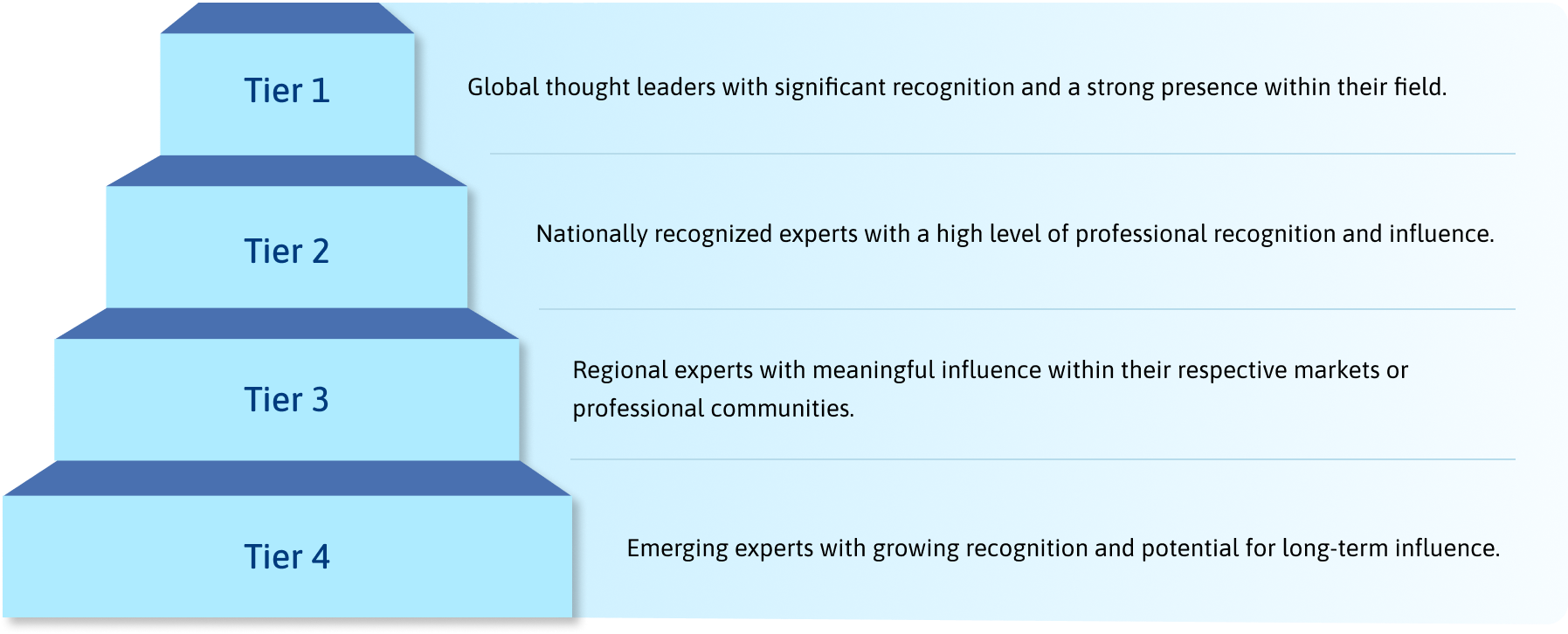
Tier 1 KOLs represent the highest level of established influence within their field. Tier 2 KOLs have strong and established professional influence, while Tier 3 KOLs have a more focused level of influence within their respective areas or communities. Emerging KOLs are experts whose recognition and influence are continuing to grow and may represent future opportunities for engagement.
KOL tiers should ideally be updated on a continuous basis rather than through annual or quarterly review cycles. Expert influence shifts as new publications emerge, trial roles change, and congress activity evolves. A static tier list loses accuracy quickly — which is why dynamic KOL tiering, where scores update automatically as new data comes in, is increasingly the preferred approach.
AI streamlines the KOL tiering process by bringing together relevant information and supporting a more consistent assessment of experts. It helps teams reduce manual effort, maintain up-to-date profiles, and identify emerging changes in the KOL landscape more efficiently.
KOL tiering is used across Medical Affairs, MSL and field medical, clinical development, and commercial and market access teams. Each team applies tier intelligence differently — from advisory board planning and MSL territory KOL tiering to investigator identification and prescribing influence mapping.
Yes. konectar’s AI-powered algorithms continuously crawl and analyze relevant data points to assess changes in expert profiles and professional influence. This enables teams to discover emerging experts and stay informed about the evolving KOL landscape.