11-05-2026
Find Your KOLs Before You Need Them: A Pre-Market Imperative for Biotech and Pharma Teams

The period between regulatory submission and FDA approval is probably one of the most underutilized windows in life sciences. Most teams wait. But here is what the smartest medical affairs and commercial teams are doing during that window: they are identifying, engaging, and building trust with the clinicians who will drive adoption of their therapy at launch.
In this article
- Why the Pre-Market Window Is the Right Moment
- The KOL Profiles That Drive Biotech and Pharma Launches
- The four signals that help identify the right clinical experts
- How the regulatory submission informs KOL strategy
- FAQs
Key opinion leaders in biotech and pharma do not just use your drug, they shape prescribing behaviour, present at conferences, and train fellows. Getting this identification right before approval is one of the highest-leverage moves any life sciences team can make.
Why the Pre-Market Window Is the Right Moment
When your therapy is under FDA review, your medical affairs and commercial teams have a rare and valuable resource: time to build relationships without the pressure of a live market.
Physicians who participated in your Phase III clinical trial already understand your molecule. Their data shaped your regulatory narrative. But clinical trial participation does not automatically make someone an effective advocate. You need to identify who among them has the peer influence, the communication credibility, and the institutional reach to move prescribing behaviour.
Equally important is that your KOL network cannot be drawn entirely from your trial investigators. You need voices from practising clinicians who represent the real-world treatment settings your therapy will enter.
The KOL Profiles That Drive Biotech and Pharma Launches
Not all KOLs serve the same commercial function. A balanced pre-launch network includes distinct profiles, each playing a different role in building clinical and market adoption.
- Peer influencers. Respected by colleagues at their institution and in their subspecialty. Their prescribing opinion shifts adoption decisions among peers who trust their clinical judgement.
- Congress voices. Active presenters at prominent congresses and other major society meetings. A single plenary session or oral abstract reaches hundreds of prescribers and payers simultaneously.
- Fellowship educators. Faculty at academic medical centres who train haematology, oncology, or immunology fellows each year. Reach multiplies through every generation of physicians they educate.
- P&T and formulary experts. Sit on Pharmacy and Therapeutics (P&T) committees and formulary decision bodies. They control whether your therapy achieves institutional formulary access, without which prescribing cannot scale.
- Guideline authors. Authors of clinical practice guidelines and society position papers. Their published recommendations shape prescribing behaviour at a national and international level.
The four signals that help identify the right clinical experts
Identifying the right KOLs is a structured process built on observable signals. Tracking these manually across thousands of publications, congress agendas, trial registries, and institutional databases is not practical for a lean medical affairs or commercial team, which is where purpose-built intelligence tools become essential.
- Publication and research activity
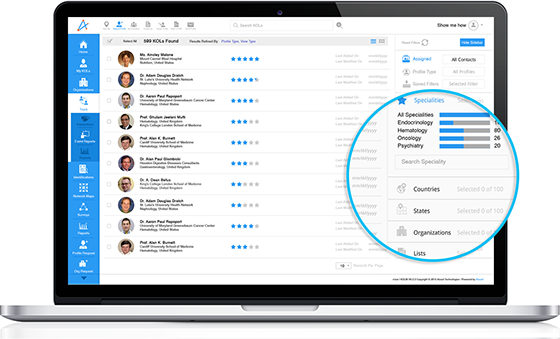
Track who is publishing in the therapeutic area and mechanism of action space. Who is first-authoring investigator-initiated trials? Authorship and citation patterns reveal scientific credibility and peer influence in ways no conversation can replicate. konectar KOL Identification surfaces these profiles, mapping and ranking experts across publication activity, trial participation, and institutional role, giving medical affairs teams a structured head start that would otherwise take months to compile manually.
- Scientific society and congress engagement
Session chairs, plenary speakers, oral abstract presenters, and society board members carry credibility. These roles signal that the medical establishment considers their voice authoritative. konectar Events maps the congress landscape across the therapeutic area, showing where your identified experts are presenting or chairing sessions, so teams can plan scientific roundtables and data readouts with the lead time they require.
- Institutional reach and training role
A physician at a major academic medical centre who trains oncology or haematology fellows each year is exponentially valuable. Training physicians multiply reach through every generation they educate.
- Genuine clinical interest in the mechanism
The best physician advocates are intellectually curious about the mechanism of action and the patient population the therapy addresses. Clinicians who are actively publishing, speaking, or seeking new options in exactly the disease space the drug targets make the most credible and committed advocates.
How the regulatory submission informs KOL strategy
Your regulatory document is the foundation of the commercial and medical narrative and the KOL engagement strategy should be built directly on it.
The patient population defined in the approved indication is the same population clinical experts need to be treating and publishing on. The primary and secondary endpoints powered in the Phase III trial are the outcomes physician advocates will reference at congress sessions and P&T presentations. The safety profile documented in the submission will be used by advocates to answer some sceptical questions.
Medical affairs and commercial teams need to work together during the submission process not sequentially after approval. By the time the FDA approval letter arrives, the network of clinical experts should already be briefed, aligned on the clinical data package, and ready to engage peers. Every interaction along the way can be logged and managed through the konectar CRM platform. This will ensure no touchpoint is lost between scientific exchange and post-approval advocacy.
FAQs
- How do teams identify the right KOLs without months of manual research?
Teams can use AI-powered KOL management platform konectar that maps and ranks clinical experts by therapeutic area, publication activity, congress presence, trial participation, and institutional role, giving teams a structured, data-driven head start that would otherwise require months of manual compilation.
- How do teams know if expert engagement is actually working?
Tracking KOL engagement quality and downstream outcomes is the way to go. CHeck if clinical experts present data at congresses? Are their institutions achieving formulary access? Are they publishing real-world evidence and referring peers? konectar CRM gives teams the visibility to track every touchpoint and connect engagement activity to commercial outcomes.
Read Next
KOLs engage most when conversations focus on the value you bring to them, not promotions. You may find this helpful: Engaging KOLs With Scientific Value, Not Sales Messaging


Recommended