09-01-2026
Winning in the Diagnostics Market: Strategic KOL Management with konectar
Influence among diagnostic companies is built on evidence, credibility, and the ability to shape clinical judgement. As diagnostic technologies grow more sophisticated and data-driven, the conversations that define market success have shifted.
Conventional Key Opinion Leader (KOL) engagement models struggle to adapt to this shift. Static lists built on publication volume or historical reputation fail to capture how influence operates in diagnostics today. They overlook emerging experts, underestimate regional and institutional authority, and ignore the informal networks where real decisions are made. As a result, engagement strategies are based on outdated assumptions and risk being misaligned.
Winning in the diagnostics market now requires a fundamentally different understanding of influence, one that’s focused on Real-World Evidence (RWE), how decisions are made, and who truly shapes outcomes across the diagnostic ecosystem.
In This Article:
- When Scientific Authority Meets Market Complexity
- Decoding Real-World KOL Impact
- Mapping Influence Where It Actually Happens
- How konectar Enables Precision KOL Profiling for Diagnostics Companies
- Redefining How Diagnostics Companies Win
When Scientific Authority Meets Market Complexity
The diagnostics market operates across overlapping ecosystems that rarely move in sync. Clinical laboratories, academic research centers, hospital systems, and emerging startups that follow distinct timelines and decision frameworks.
For example, a highly cited researcher may shape early scientific direction while a lab director determines validation standards. Market momentum is often driven by practitioners whose authority stems from operational expertise rather than academic prominence.
This complexity challenges the traditional approach to KOL engagement. Models built around “top published” experts assume influence is centralized and uniform. When engagement strategies fail to account for this, the consequences are tangible. Resources are directed towards voices with limited impact on adoption. Critical stakeholders are engaged too late or not at all.
Navigating this market requires a precise understanding of how influence shifts across settings, roles, and stages of decision-making.
Decoding Real-World KOL Impact
Reputation has long been used as a proxy for influence in diagnostics. While these traditional metrics indicate scientific standing, they do not reliably explain who shapes real-world decisions. Visibility reflects how often a work is cited, but credibility reveals trust within a peer group.
Real-world KOL impact is, therefore, deeply contextual. An expert’s influence depends on their role, environment, and proximity to decision-making. Accurate KOL profiling must reflect this reality. It requires moving beyond reputation-based indicators toward role-specific insights, i.e., capturing not just who is respected, but also who actually moves the market.
Mapping Influence Where It Actually Happens
Modern KOL profiling begins with understanding that influence spheres operate under different rules and exercises that influence in novel ways. Decision-making in diagnostics is frequently regional as well, shaped by local regulations. A regional opinion leader may have limited global visibility yet exert decisive authority within a specific healthcare ecosystem.
Ignoring these dimensions leads to blind spots in engagement and missed opportunities for impact. Mapping influence requires a multidimensional view that captures role, context, geography, and networks. With that, engagement can be precise and effective.
How konectar Enables Precision KOL Profiling for Diagnostic Companies
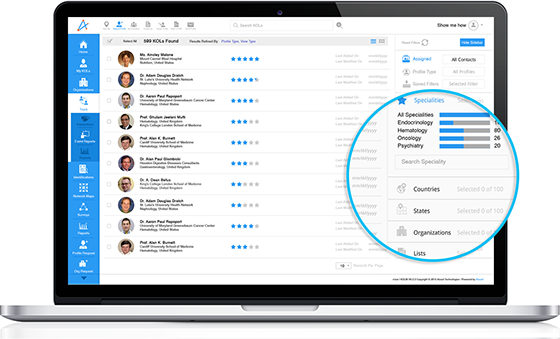
konectar approaches the dynamic landscape of influence in diagnostic companies by continuously applying advanced analytics to surface relevant experts across clinical, academic, and translational domains.
konectar evaluates multiple influence signals in parallel. Scientific output is considered alongside clinical adoption patterns, institutional affiliations, and collaboration activity. By mapping how experts connect to institutions, regions, and peer networks, it becomes possible to understand not just who matters but why they matter in a contextual scenario.
These insights are structured to support distinct organizational needs. Teams gain clarity on scientific leadership and peer credibility. Commercial teams get a clearer view of adoption drivers and regional authority. This integrated picture of influence provides a holistic understanding of the ecosystem.
If you’d like to see konectar in action, get in touch with our team by scheduling a demo.
Redefining How Diagnostics Companies Win
Navigating the complex environment of diagnostic companies requires clarity, as it spans roles and networks. Diagnostic companies that can see this landscape clearly are better positioned to prioritize engagement, allocate resources efficiently, and adapt their strategies with confidence.
konectar supports this shift by bringing structure to complexity. By translating fragmented influence signals into coherent intelligence, enabling diagnostic organizations to engage with precision and purpose.


Recommended