10-02-2026
How AI-Powered Platforms Support More Structured HCP Discovery
For decades, life sciences teams have built HCP lists using a few simple signals: sales rep feedback, attendance at medical meetings, and past prescription volume. These sources were easy to collect, but they are incomplete and static.
There are a few challenges with such a model:
- Sales rep feedback reflects who reps see most, not who influences clinical practice.
- Conference attendance flags visibility, not clinical impact.
- Prescription volume alone measures quantity, not the quality of influence.
An approach like this treats HCP influence like a single number, often a rank based on past activity that fails to capture real clinical relevance or field leadership. In practice, this leads to repeated targeting of the same physicians while emerging and regionally influential HCPs seem unseen.
Prescription volume is still widely used as a discovery filter, despite its limited ability to surface clinically relevant HCPs. Many guideline contributors, trial investigators, and referral influencers operate at low volumes and never appear in traditional target lists.
In This Article
- The Data Problem AI Actually Solves
- How AI Builds Multi-Dimensional HCP Profiles
- Where AI Still Needs Human Judgment
- Measuring Impact: What Better Discovery Looks Like
- In Conclusion: Structured Discovery Can Be a Competitive Advantage
The Data Problem AI Actually Solves
Traditional HCP discovery metrics are important, but they are incomplete and siloed. Modern healthcare data exists in hundreds of fragmented sources that don’t naturally “talk to each other”. AI’s core value in HCP discovery lies in integrating these disparate sources into a usable profile.
AI platforms consolidate and connect data
They take in structured data and unstructured signals from text, publications, and registries. Machine learning and semantic models reconcile terminology differences and align heterogeneous records into a unified profile. This goes beyond traditional database matching; it yields multi-dimensional HCP profiles that reflect practice behaviour, research activity, and professional visibility.
Manual efforts cannot reconcile thousands of touchpoints
Healthcare systems produce massive volumes of data that would require massive amounts of time and expertise to curate manually. AI models can detect patterns and signal strength across sources that would otherwise remain invisible.
Why this matters for HCP discovery
An HCP with a modest prescribing footprint may still:
- Publish high-impact research
- Lead trials in a therapeutic niche
- Speak at major conferences
- Influence peer networks through co-authorship
Traditional lists miss these signals, but AI can surface them by fusing multiple data streams into a structured, queryable format.
How AI Builds Multi-Dimensional HCP Profiles
Traditional discovery models rank HCPs on one dimension, most commonly being prescription volume or simple specialty filters. Single metrics such as these miss the complexity of real professional influence. Modern AI platforms go further by combining multiple, heterogeneous signals into a single unified profile.
AI-powered systems scan:
- Clinical expertise indicators, such as published research and guideline participation, demonstrate deep domain knowledge and peer recognition.
- Research influence reflected by authorship citations and trial involvement; signals often correlated with thought leadership rather than just prescribing behavior.
- Network Centrality, or how connected a provider is within professional referral and collaboration networks, reveals who actually moves ideas and patients across systems.
- Digital engagement metrics, such as participation in online forums, webinars, and educational content, indicate topical relevance and peer visibility.
Multi-dimensional matters when it comes to HCP discovery because different stakeholder use cases require different types of HCPs. Speakers need a recognized communication reach. Advisors need scientific credibility and network influence. A composite profile lets teams segment HCPs by strategic role rather than by a blunt aggregate score.
Where AI Still Needs Human Judgment
AI platforms still excel at pattern detection. They surface signals across multiple touchpoints that no individual team could assemble manually. What they do not possess is situational context. Local relationships matter. And HCP’s formal influence may look strong on paper, but AI cannot infer trust, history, or interpersonal dynamics.
Institutional politics also exist outside the data. Hospital hierarchies, department leadership changes, and informal decision-makers rarely appear in structured datasets. Human judgment can fill these gaps.
Therapeutic nuance is also critical. Two HCPs with similar profiles may have very different clinical philosophies. One may favour aggressive innovation, another may be risk-averse. These distinctions often appear through dialogue.
This is why most effective platforms are designed to keep humans in mind throughout the entire HCP discovery journey. The strongest operating model is iterative: AI proposes, teams validate, and feedback refines the system over time.
In practice, teams that treat AI as an advisor rather than an authority show higher trust and sustained adoption.
Measuring Impact: What Better Discovery Looks Like
The impact of AI-driven HCP discovery is not proven by model scores or dashboards. It shows up in how teams operate day to day.
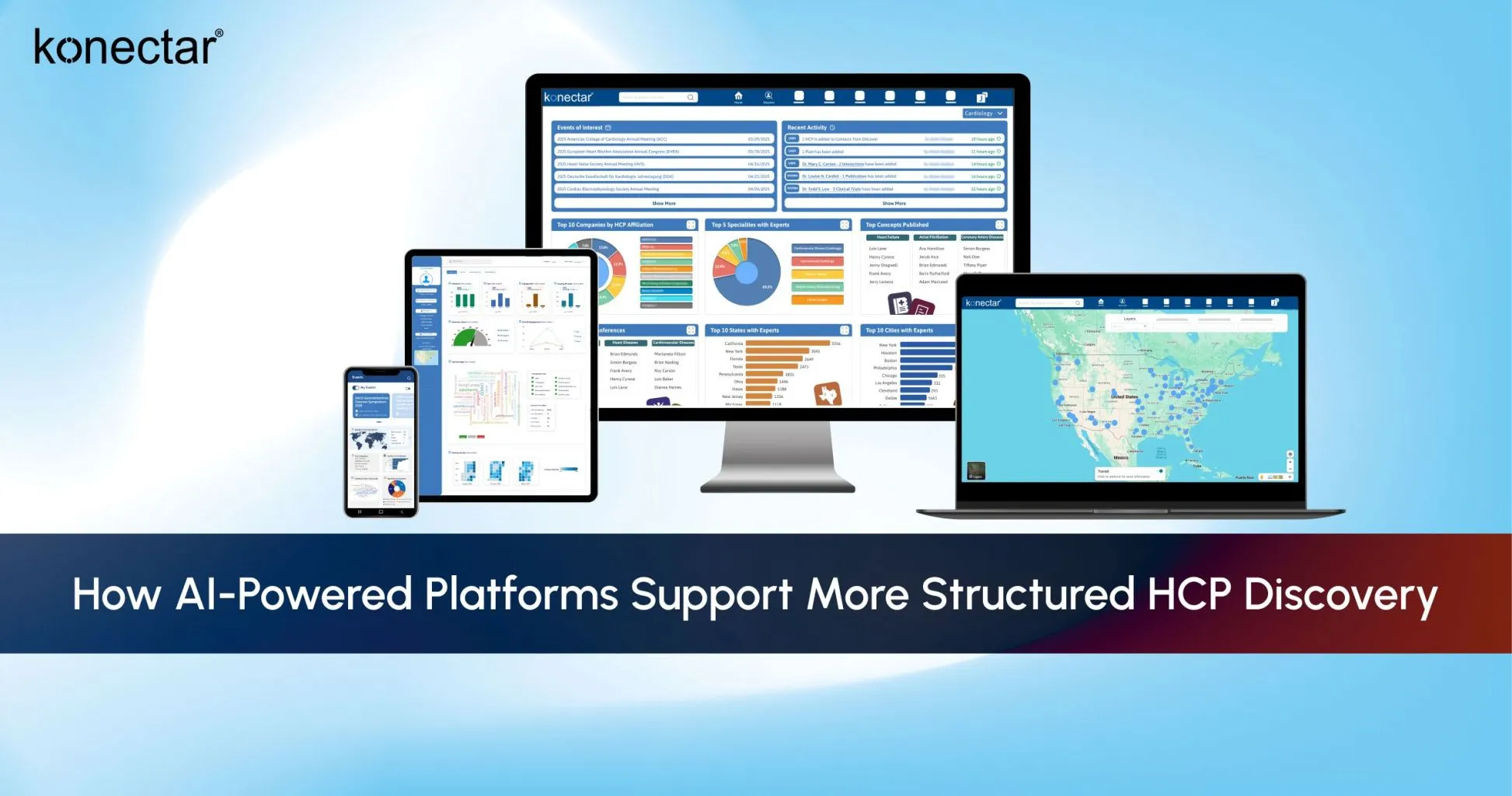
One of the earliest signals is reduced targeting overlap. Platforms such as konectar helps teams surface HCPs using multiple independent signals. This allows teams to move beyond the same legacy shortlists. Coverage expands without increasing noise.
Another advantage is engagement quality. When discovery is grounded in role, expertise, and network relevance, outreach becomes more timely and specific. Teams engaging HCPs, newly identified by konectar, see stronger engagement alignment with HCP preferences.
Speed is also measurable. Advisory boards, speaker programs, and research collaboration form faster when relevant experts are already identified, contextualized, and ranked with supporting evidence. Less time is spent on debating who belongs on which list.
In Conclusion: Structured Discovery Can Be a Competitive Advantage
AI-powered platforms do not just increase the number of HCPs identified. They change how discovery decisions are made. Tools like konectar make discovery logic explicit. Teams can see why an HCP appears on a list and which touchpoints are assigned what weightage. This transparency matters when it comes to compliance and cross-functional alignment.
Most importantly, it shifts engagement behaviour. Teams move beyond reactive targeting to intentional selection. HCPs are engaged based on their role and timing within the ecosystem, not because they are on a list.
Explore konectar and the value its AI-powered HCP discovery module can add to your team. To get started, book a demo.


Recommended