04-07-2024
Leveraging Oncology KOL Data for Better Cancer Treatment Strategies
Every breakthrough in cancer treatment begins with the expertise of those pushing the boundaries of medical science. A precise oncology KOL database brings that expertise into focus by mapping the experts’ influence, research, and collaborations that shape oncology today. By leveraging these insights, medical affairs teams can identify true thought leaders, uncover new research directions, and craft data-driven strategies that accelerate progress in cancer care.
In this article, we will explore the importance of oncology KOL data, sources, and methods of collecting them.
In this article:
- 1. Key Sources for Gathering KOL Data in Oncology
- 1.1 Medical Conferences and Symposia
- 1.2 Clinical Trials and Research Publications
- 1.3 Expert Interviews and Surveys
- 2. Oncology KOL Data Collection and Analysis Techniques
- 2.1 Data Mining and Text Analysis
- 2.2 Network Analysis and Key Opinion Leader Mapping
- 2.3 Machine Learning and Predictive Analytics
- 3. How AI-Powered konectar Oncology Makes the Process Seamless
- 4. FAQs
1. Key Sources for Gathering KOL Data in Oncology
1.1 Medical Conferences and Symposia
Medical conferences and symposia serve as vital platforms where KOLs share their expertise, present research findings, and discuss the latest oncology developments. Through keynote speeches, panel discussions, and research presentations, these events offer valuable insights into new treatment approaches and trends.
1.2 Clinical Trials and Research Publications
KOLs play pivotal roles in structuring, conducting, and analyzing clinical trials. By leading or actively monitoring clinical trials, they generate crucial data on treatment efficacy, safety profiles, and patient outcomes, that inform evidence-based decision-making.
Their peer-reviewed publications in scientific journals enrich the knowledge base that guides oncology treatment protocols and guidelines, providing significant information about their body of work that shapes cancer treatment strategies.
1.3 Expert Interviews and Surveys
Direct engagement with KOLs through interviews and surveys provides qualitative insights into their perspectives, experiences, and opinions on various aspects of cancer care. These interactions reveal thought processes, decision-making frameworks, and priorities in oncology research and practice.
2. Oncologists KOL Data Collection and Analysis Techniques

2.1 Data Mining and Text Analysis
Data mining involves extracting insights and patterns from large datasets, while text analysis focuses on analyzing unstructured text data such as research papers, conference abstracts, and social media posts.
Advanced data mining techniques, including natural language processing (NLP) algorithms, sift through vast amounts of text data to identify key opinion leaders, their areas of expertise, and the topics they frequently discuss.
2.2 Network Analysis and KOL Mapping
Network analysis involves mapping the connections between oncologists, researchers, academic institutions, and healthcare organizations.
By analyzing this data, companies can identify key opinion leaders and their spheres of influence. This information can be used to prioritize outreach efforts, foster collaborations, and foster collaboration.
2.3 Machine Learning and Predictive Analytics
Machine learning involves building predictive models from data to make informed decisions. Predictive analytics uses statistical techniques to forecast future trends. Pharmaceutical companies leverage these techniques to analyze a wide range of data sources to gain insights into preferences, needs, and challenges faced by oncologists.
3. How AI-Powered konectar Oncology Makes the Process Seamless?

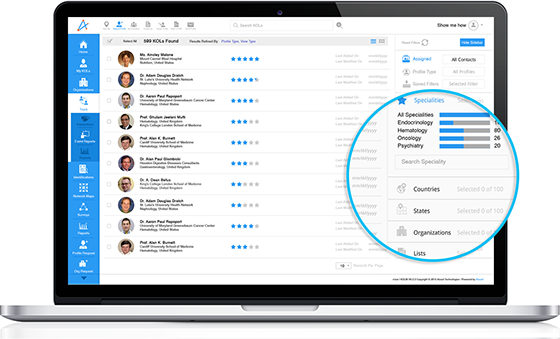
konectar Oncology, powered by advanced AI technology, has revolutionized the process of discovering, profiling, and engaging oncology Key Opinion Leaders (KOLs). The platform employs intelligent AI techniques to crawl and analyze vast amounts of information from diverse sources such as medical journals, clinical trials, conference proceedings, and social media, ensuring comprehensive and up-to-date data on oncology experts.
The platform’s AI-driven network analysis maps connections between oncology experts and institutions, aiding in identifying KOLs and understanding collaborations crucial for strategic partnerships.
Leading pharmaceutical companies worldwide have implemented konectar to gain KOL insights and improve decision-making. To accelerate your KOL management efforts, request a demo of konectar today.
FAQs
- How does AI enhance the process of profiling oncology KOLs?
AI integrates and analyzes data from diverse sources to create detailed profiles, including speaking engagements, affiliations, research activities, and influencer networks. AI-driven analysis ensures accurate, comprehensive profiling to identify the most relevant KOLs.
- What are the benefits of using AI for KOL data analysis?
AI offers several benefits for KOL data analysis, including improved accuracy, efficiency, and comprehensiveness. AI-driven tools can analyze large volumes of data quickly, identify patterns and trends, and provide personalized recommendations.
- What are the advantages of using AI-powered platforms like konectar Oncology?
AI-powered platforms like konectar Oncology offer several advantages, including accurate KOL profiling, enhanced network analysis, predictive analytics, personalized recommendations, and competitive intelligence.


Recommended