Effective HCP interaction tracking
and engagement monitoring can help
life sciences organizations build
stronger relationships and drive
better engagement outcomes. Yet most
organizations capture HCP
interactions through disconnected
systems. This fragmentation causes
missed opportunities, duplicated
outreach, compliance risk, and keeps
relationships from reaching their
full potential. By bringing HCP
touchpoints together, teams gain a
clearer view of engagement and make
more informed decisions.
Monday, August 24, 2026
What is HCP Interaction and Engagement
Tracking in Life Sciences?
Interaction and engagement are foundational
to meaningful outcomes across the life
sciences landscape. Interaction refers to
purposeful, compliant, value-driven
touchpoints between life sciences
professionals and Key Opinion Leaders
(KOLs). Engagement goes further: it is a
measure of the sustained, meaningful
relationship between an organization and its
key scientific stakeholders.
Unlike siloed note-taking or basic activity
logging, systematic HCP interaction capture
and HCP engagement tracking means:
1. Every interaction, whether a 1:1 MSL
visit, a conference conversation, an
advisory board session, a webinar
attendance, a publication collaboration,
or a medical information call, is
captured in a unified profile.
2. Interactions are linked across teams
and channels, so the full picture of
engagement is visible to anyone who
needs it.
3. Engagement data feeds into
relationship intelligence, helping teams
decide how, when, and why to engage
next.
4. All interaction records support
compliance and documentation
requirements.
This is what separates a basic activity log from
a truly connected engagement system, and it
makes all the difference in how relationships
evolve over time.
The HCP Relationship Challenge:
Why Fragmentation Fails
Before examining how systematic
tracking strengthens HCP
relationships, it is worth
understanding why fragmented
engagement management actively
harms them.
The Problem of Disconnected
Touchpoints
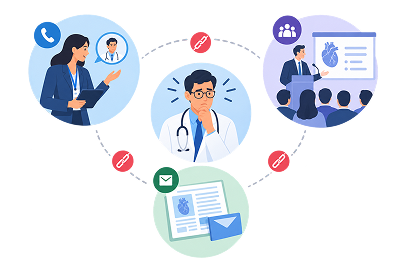
A leading cardiologist may
be contacted by an MSL on
Monday, attend a sponsored
symposium on Wednesday, and
receive a publication
reprint on Friday, all from
the same organization, yet
none of these teams has
visibility into what the
others have done. The HCP
experiences repetition
without coherence: the
opposite of a thoughtful
scientific relationship.
Knowledge Loss During
Attrition
When a field medical team
member transitions
territories or leaves the
organization, their
knowledge of a KOL's
preferences, past
conversations, research
interests, and unmet
questions leaves with them
unless it was systematically
captured. Without connected
tracking, every relationship
effectively resets, forcing
the new team member to
rebuild trust from scratch.
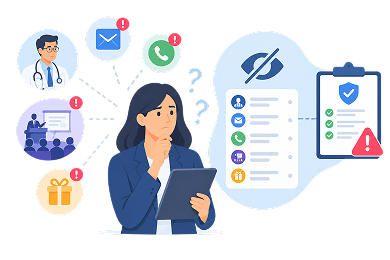
Compliance Blind Spots
Without a connected view of
interactions, organizations
cannot easily distinguish
between medical and
promotional engagements,
cannot detect
over-engagement with
specific HCPs, and cannot
generate audit-ready
documentation. This creates
regulatory exposure that is
entirely avoidable with
structured, linked
interaction records.
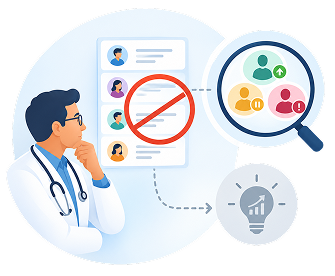
The Missed Opportunity Cost
When interactions are not
logged systematically,
organizations lose the
ability to spot patterns:
which HCPs are deeply
engaged, which are drifting,
and which have raised
recurring scientific
questions that deserve a
formal response or
collaborative study. This
may translate directly into
missed scientific and
strategic opportunities.
What Changes When Engagement Becomes
Systematic
When engagements are captured consistently and
connected over time, teams build something that
cannot be replicated through effort alone: a
living record of the relationship. Every
conversation, follow-up, and scientific exchange
contributes to a portrait of the HCP that grows
richer with each interaction.
This continuity changes how HCPs experience the
relationship. When they see that their questions
were remembered, their commitments were honored,
and their scientific interests were genuinely
tracked, the engagement shifts from
transactional to collaborative, from periodic
outreach to ongoing scientific dialogue.
It also changes who owns the relationship. When
interactions are systematically documented, the
relationship belongs to the organization, not to
any single person. Every incoming team member
can pick up where the last left off, with full
context.
At scale, the patterns embedded in systematic
interaction data surface insights such as which
relationships are strengthening, which are at
risk of going quiet, and where engagement has
been meaningful versus surface-level. These are
the questions that let medical affairs teams
move from reactive relationship management to
purposeful, intelligence-driven engagement
strategy.
What to Look for in a CRM Built for
Interaction and Engagement Tracking
Instead of relying on separate interaction
tracking software for pharma and other life
sciences, teams can use a unified CRM as a
single source of truth for HCP data. It brings
interaction history, engagement activity,
relationship information, and the HCP management
lifecycle together in one place.
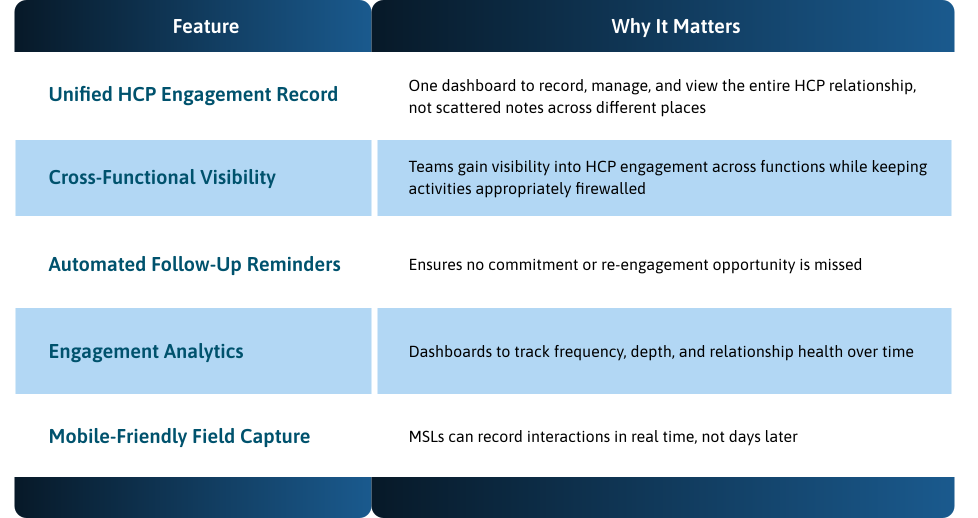
How konectar Delivers This
Interaction and engagement capabilities are part
of konectar CRM. Together, these features give
life sciences teams a single, structured
environment where every HCP touchpoint is
captured and connected.
Interaction Logging
Every field visit, advisory board,
congress engagement, and scientific
exchange is recorded against the
HCP's profile, building a
relationship history that persists
across team changes.
Engagement Timelines
A chronological view of all
interactions with each HCP, giving
teams instant context before every
outreach.
Cross-Team Engagement View
Gives teams visibility into
essential cross-channel interaction
data, helping keep HCP engagement
coordinated and consistent across
the organization.
Sentiment & Response Tracking
Teams capture qualitative signals,
areas of interest, follow-up
commitments and more, turning every
conversation into structured
intelligence.
Engagement Analytics
Insightful analytics reveal patterns
across the HCP landscape,
identifying deepening relationships,
at-risk connections, and
opportunities for meaningful
re-engagement.
konectar CRM brings every touchpoint
into one structured view, giving
teams a complete picture of every
HCP relationship.
HCP interaction and engagement is the backbone
of every high-performing HCP relationship
strategy. Brought together in one system,
fragmented, forgettable touchpoints become a
coherent narrative of scientific partnership.
For life sciences teams building lasting
relationships with the HCPs who shape clinical
practice and scientific thinking, systematic
capture and tracking is not optional; it is
essential.
Frequently Asked Questions
Interaction refers to a single,
purposeful touchpoint with an HCP,
such as an MSL visit, a conference
conversation, or a medical
information call. Engagement is
broader: it reflects the sustained,
meaningful relationship built across
many interactions over time.
Systematic interaction tracking
keeps every HCP engagement
documented and traceable. This helps
teams monitor interaction frequency,
maintain appropriate engagement
practices, and quickly access
records when documentation is
required.
Without systematic capture, an HCP's
preferences, past conversations, and
unmet questions leave with the
departing team member, and the
relationship effectively resets.
When interactions are logged
centrally, incoming team members
inherit full context and history.
A basic activity log records that
something happened. Systematic
tracking connects interactions
across teams and channels, feeds
engagement data into relationship
intelligence, and keeps every record
compliance-aligned, turning isolated
entries into a coherent relationship
history.
Yes. Interaction logging, engagement timelines, sentiment tracking, and cross-team visibility are core capabilities of konectar CRM, the HCP relationship management module within the konectar platform.